

TOM AND JERRY: FORBIDDEN COMPASS (2026)
Genre: Animation
Director: Zhang Gang
Runtime: 1 hr 44 mins
Rating: PG
Released By: Golden Village
Official Website:
Opening Day: 7 May 2026
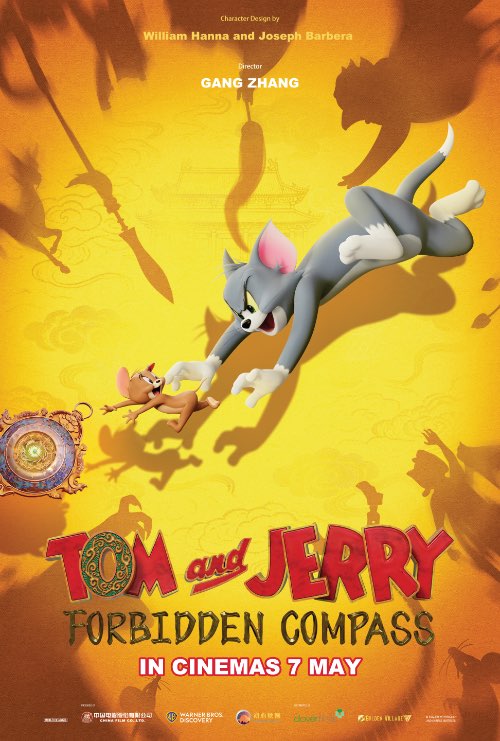
Synopsis: During a chase inside a museum, Tom and Jerry find a magical object and end up being transported through time. Lost in a distant era, they will need to work together to find a way back home.
Movie Review:
For anyone still keeping count, Tom and Jerry: The Forbidden Compass marks the 18th instalment in the long-running Tom and Jerry film series. While the franchise may not occupy the same cultural pedestal as Disney’s Mickey Mouse & Friends or the anarchic legacy of Looney Tunes, the iconic cat-and-mouse duo has endured for decades because of a simple but reliable formula: Tom devises elaborate schemes to catch Jerry, Jerry outsmarts him, and Tom inevitably ends up flattened, exploded, electrocuted, or otherwise humiliated in the process. It is slapstick chaos audiences know and love.
Strangely enough, that classic dynamic is not really the focus here.
Produced by Origin Animation as a United States-China co-production with Warner Bros. Pictures and China Film Group, this movie takes the franchise in an unexpected direction. The film follows Tom and Jerry after they accidentally activate a magical compass inside a museum, transporting themselves into another realm inspired heavily by ancient Chinese mythology and folklore. What unfolds is less a traditional Tom and Jerry adventure and more a fantasy quest steeped in Chinese cultural imagery.
This alternate world is filled with references that will feel familiar to viewers accustomed to Chinese fantasy epics: celestial deities, traditional opera performances, lantern-lit villages, and communities devoted to honouring gods and spirits. Visually, the movie fully embraces this aesthetic, often looking like it wants to belong in the same cinematic space as modern Chinese animated blockbusters.
That, however, also contributes to the film’s oddly disjointed identity. Everything on screen feels deeply Chinese in tone and inspiration, yet the dialogue of the version we watched is entirely in English — including local sayings and idioms that sound unusual when translated so directly. There is even a rap sequence that clearly resembles the structure and rhythm of a Chinese musical performance, except it is delivered in English, creating a tonal disconnect that is difficult to ignore.
Perhaps the strangest part is how little Tom and Jerry themselves matter after a while. Once the story gains momentum, attention shifts heavily toward a storyline involving a deity attempting to return to heaven. The famous duo often feel like passengers within someone else’s fantasy adventure, rather than the emotional or comedic centre of the film. There are stretches where viewers may genuinely forget they are watching a Tom and Jerry movie at all.
To the film’s credit, the animation is polished and energetic. The pacing rarely slows and younger audiences will likely remain engaged thanks to the constant movement, colourful visuals and fast-moving action sequences. The fantasy world itself is detailed and vibrant, clearly made with ambition and care.
Still, there is an unavoidable sense that the film exists awkwardly between identities — too culturally specific to feel like a conventional Hollywood Tom and Jerry outing, yet not quite distinctive enough to stand alongside modern Chinese animated spectacles. Throughout the movie, one cannot help but think of Ne Zha 2, a far more confident and emotionally resonant example of mythological animation done right.
By the time Tom and Jerry eventually return to the museum, viewers may find themselves asking the same question: what exactly did we just watch? It is not necessarily a bad film, merely an oddly positioned one — a cultural hybrid that never fully figures out how to balance its iconic cartoon stars with the mythological fantasy surrounding them.
Movie Rating:

(Colourful and chaotic, the soul of Tom and Jerry feels missing in action in this curious cultural mash-up)
Review by John Li
You might also like: