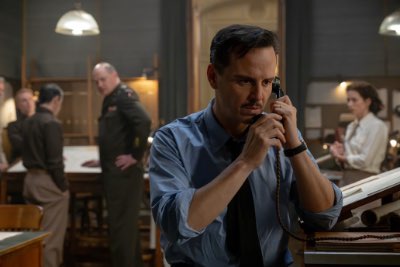


PRESSURE (2026)
Genre: War/Thriller
Director: Anthony Maras
Cast: Andrew Scott, Brendan Fraser, Kerry Condon, Chris Messina, Damian Lewis
Runtime: 1 hr 40 mins
Rating: PG13 (Some Violence and Coarse Language)
Released By: Shaw Organisation
Official Website:
Opening Day: 28 May 2026
Synopsis: In the tense 72 hours before D-Day, and with the fate of the free world hanging in the balance, PRESSURE follows General Dwight D. Eisenhower and Captain James Stagg as they face an impossible choice—launch the largest and most dangerous seaborne invasion in history or risk losing the war altogether.
Movie Review:
Anthony Maras’ Pressure arrives with one obvious challenge: how do you make D-Day feel uncertain when the whole world knows the date? The Battle of Normandy has been studied, filmed and mythologised from almost every angle: the soldiers on the beaches, the generals in the map rooms, the leaders weighing the fate of Europe. What makes Pressure so absorbing is that it finds a fresh way in. It shifts attention to Group Captain James Stagg, the Scottish meteorologist whose advice helped decide whether the largest seaborne invasion in history would go ahead, be delayed, or possibly end in disaster.
That may sound like the least cinematic corner of the war, but Maras understands that forecasting, in this case, is action. The drama is not in explosions but in pressure charts, changing winds, cloud cover, moonlight and tides. The question is simple and terrifying: can Stagg persuade men who command armies that the weather will not obey their timetable? Andrew Scott plays him as a tightly wound professional, awkward in rooms where confidence matters more than caution, but stubborn enough to keep returning to the evidence. Opposite him is Chris Messina’s Irving P. Krick, the American forecaster whose sunnier prediction is exactly what everyone wants to hear. Their clash gives the film a clear human shape: instinct versus data, charm versus rigour, convenience versus truth.
Maras has worked with playwright David Haig to turn Haig’s 2014 stage play into a fine British drama that keeps much of the theatre’s verbal tension while opening it out just enough for the screen. The film is set largely across the tense 72 hours before D-Day, and its best scenes show Stagg having to hold his own against senior Allied figures, including Brendan Fraser’s Dwight D. Eisenhower and Damian Lewis’s Bernard Montgomery. He is not a battlefield hero in the usual sense. He is a man in a uniform, standing before more powerful men and saying no, or not yet, because the facts demand it.
That is where Pressure feels most alive today. At its heart, this is a film about speaking truth to power. Stagg does not have the luxury of being liked. He cannot soften his message because it is inconvenient, nor can he dress uncertainty up as certainty. In a climate where public argument often rewards volume, loyalty and easy answers, the film’s respect for evidence feels quietly urgent. It reminds us that expertise is not arrogance, and that leadership sometimes means listening to the person in the room who is making everyone uncomfortable.
But Pressure is not only a procedural about maps and military timing. It is also a personal drama about the cost of professionalism. Stagg has left behind his heavily pregnant wife, Liz, and the film tightens around him when he learns that the hospital where she is staying has been bombed. For a time, he does not know whether she or the baby has survived. Scott is excellent in these moments because he does not overplay them. Stagg’s pain is visible, but it is trapped behind duty. He must keep thinking clearly when any ordinary person would be unable to think at all.
The ensemble is strong across the board. Fraser gives Eisenhower a heavy, humane presence; his authority is real, but so is his fear of sending thousands of men into the wrong conditions. Kerry Condon brings warmth and sharpness as Kay Summersby, giving the film a needed note of emotional intelligence. Messina makes Krick more than a simple rival, while Lewis enjoys Montgomery’s vanity and force without turning him into a cartoon. Around Scott, they create a room full of competing egos, anxieties and instincts.
Pressure may not reinvent the war film, and some of its stage origins remain visible in the speeches and confrontations. Yet that is also part of its strength. It is a talky film about action, a war film where the decisive battle is fought before the landing craft move. By focusing on the man who had to read the sky and risk being wrong, Maras gives a familiar history a bracing new charge. The result is intelligent, tense and deeply human: a reminder that history can turn not only on courage under fire, but on the courage to tell powerful people what they do not want to hear.
Movie Rating:


(Pressure is a tense, humane D-Day drama that finds fresh urgency in James Stagg’s battle to speak scientific truth to military power)
Review by Gabriel Chong
You might also like:
.jpg)
.jpg)
Movie Stills

.jpg)