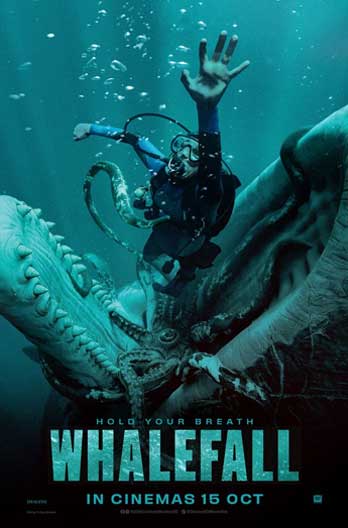


WHALEFALL (2026)
Genre: Thriller
Director: Brian Duffield
Cast: Austin Abrams, Josh Brolin, Elisabeth Shue, John Ortiz, Jane Levy, Emily Rudd
Runtime: 1 hr 46 mins
Rating: PG13 (Some Intense Sequences & Coarse Language)
Released By: Walt Disney
Official Website:
Opening Day: 15 October 2026
Synopsis: Following the death of his father (Josh Brolin), Jay Gardiner (Austin Abrams) goes diving off the central Coast of California in search of his remains, but is swallowed by a massive sperm whale. While trapped inside its belly with only one hour of oxygen left, Jay comes to realize that the hard-earned lessons his father imparted may be the key to his escape.
Movie Review:
There is something about being trapped alone on the brink of death that gives a person clarity about the troubles he has been carrying. Like many survival thrillers before it, ‘Whalefall’ puts its protagonist through an ordeal that forces him to reconsider the life he might lose. Its particular predicament is certainly unusual, but beneath the prospect of being digested by a sperm whale lies something familiar: a young man struggling with the grief, anger and guilt left behind by his father’s suicide a year earlier.
That young man is Jay Gardiner (Austin Abrams), a college student who returns to Monterey, California, determined to recover his father’s remains from the ocean. Before delivering on its extraordinary premise, the film spends roughly half an hour acquainting us with Jay and his late father Mitt (Josh Brolin), an experienced diver whose insistence on toughening up his son frequently tipped into cruelty. Mitt wanted Jay to embrace the sea as he did; Jay wanted room to be himself. Their unresolved relationship supplies the emotional anchor for everything that follows.
Setting out alone with his old diving equipment, Jay encounters a giant squid being hunted by a massive sperm whale. A tentacle catches his ankle, and he is dragged into the whale along with its intended meal. He comes round inside a stomach chamber with about an hour’s air remaining and precious little to work with. A plastic bag and an old sock join the miscellaneous items at his disposal, and you hardly need to be an expert in survival thrillers to know that such apparently random objects will eventually earn their keep.
Once inside, ‘Whalefall’ delivers some grippingly unpleasant spectacle. Jay moves from chamber to chamber through an environment that can squeeze him, burn him or simply deny him another breath. The walls twitch and contract, digestive fluids threaten exposed skin, and even the swallowed squid remains a danger. The effects make this fleshy prison feel disturbingly tangible, while the sound design reminds us that it belongs to an enormous living creature. There is also an unexpected beauty to the bioluminescent life within, including a jellyfish that briefly offers Jay something resembling company.
Director Brian Duffield and co-screenwriter Daniel Kraus, adapting Kraus’s novel, intersperse these close shaves with flashbacks to Jay’s childhood and adolescence. The practical lessons Mitt drilled into him become crucial to his survival, even as remembering their delivery reopens old wounds. At its best, the film allows those memories to complicate Jay’s resentment. At its weakest, it treats his predicament as an elaborate demonstration of paternal wisdom, arranging each recollection a little too neatly around the next problem he must solve. Later, Mitt’s voice seems to accompany Jay inside the whale, bringing comfort and confrontation together in a sequence that is both strange and sincere.
This is where the film is likely to divide audiences. Those caught up in the immediate danger may grow impatient whenever the action pauses for another argument between father and son. The increasingly explicit symbolism can also feel unnecessary when the idea of Jay being consumed by his past is already clear. Nor does useful diving advice automatically redeem a parent’s bullying. The screenplay occasionally seems to hurry past that distinction on its way towards an emotional reconciliation, asking us to accept more than the flashbacks have earned.
But the performances give us reasons to stay with it. Abrams makes Jay’s vulnerability easy to invest in, conveying panic and exhaustion despite spending much of the film with a regulator in his mouth. His flashes of incredulous humour provide welcome relief from the suffering. Brolin is less restrained, and Mitt’s bluster sometimes overwhelms the quieter emotions beneath it, but there is something painful in a father whose determination to prepare his son for life has left him ill equipped to understand him.
For us, though, the film’s sincerity ultimately counts for more than its uneven construction. There is an elegiac quality to Jay’s struggle with someone who can no longer explain himself, apologise or change. His memories are all he has, and returning to them allows him to recognise that love, anger and disappointment can coexist. The most affecting possibility here is that he can carry forward what his father taught him while relinquishing the need to keep answering to him.
‘Whalefall’ does not always trust that thought enough to let it emerge quietly, and its emotional insistence will leave some viewers unmoved. Yet its clumsy passages do not entirely diminish its feeling for what it takes to go on living. We often carry our losses as though putting them down would betray the people attached to them. This strange, bruising film suggests that we can acknowledge the hurt, learn from whatever good remains, and give ourselves permission to move forward, one step at a time.
Movie Rating:


(Uneven but gripping, ‘Whalefall’ turns an extraordinary survival ordeal into a moving reflection on grief, a troubled father–son bond and learning to let go)
Review by Gabriel Chong
You might also like: