

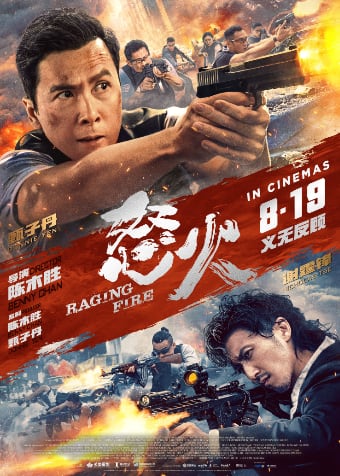
RAGING FIRE (怒火) (2021)
Genre: Action/Thrller
Director: Benny Chan
Cast: Donnie Yen, Nicholas Tse, Qin Lan, Patrick Tam, Kenny Wong, Deep Ng, Jena Ho, Angus Yeung, Bruce Tong, Henry Mak, Yu Kang, German Cheung, Tony Wu, Ray Lui, Simon Yam, Ben Yuen, Ben Lam, Ken Low, Carlos Chan
Runtime: 2 hrs 6 mins
Rating: NC16 (Violence and Coarse Language)
Released By: mm2 Entertainment
Official Website:
Opening Day: 19 August 2021
Synopsis: While conducting a raid to arrest a drug lord, the police encounter a team of masked thugs. In a stunning act of sabotage, the thugs steal the drugs and murder the police officers on the scene. Arriving late, Inspector Cheung Shung-bong (Donnie Yen) is devastated to see the brutal aftermath of the carnage. After investigating overnight, Bong discovers that the cop killers are led by Ngo (Nicholas Tse), a former fellow cop. Behind Ngo’s scar is a tragic story of a police force rising star who is forced into a life of crime, and the man who pushed Ngo into crime was none other than Bong. As the two men’s fates are entangled again, it’s time to settle the score once and for all...
Movie Review:
One sad fact that will forever be tied to Raging Fire is that it marks the final completed work of one of Hong Kong’s finest action directors, Benny Chan. Known for films like A Moment of Romance and Big Bullet, Chan sadly passed away last August after a brief battle with cancer. On a brighter note, the film also gives us a new Donnie Yen movie, always a welcome treat for action fans.
Chan shares story credits with Ryan Ling (Hand Rolled Cigarette) and Tim Tong (Call of Heroes) in this frustratingly average crime flick that explores police politics and brotherhood. Given the combined star power of Yen and Nicholas Tse, expectations are undeniably sky-high, but the film ultimately settles as a passable, if entertaining, actioner.
Within minutes, the story establishes Bong (Yen) as a by-the-book, capable, and committed cop who is happily married to his pregnant wife (an underused Qin Lan). However, Bong is haunted by a past incident that is gradually revealed. Soon after, his mentor (Ray Lui) and colleagues are brutally killed during a drug bust by a group of masked assailants. Unsurprisingly, Bong vows revenge, setting off a series of confrontations and explosive action sequences.
Unless you’ve been avoiding trailers and promotional material, you’ll already know that Tse plays the main antagonist, Ngo, opposite Yen’s righteous hero. Ngo and his crew were once police officers but were imprisoned after killing a suspect. Formerly a promising cop under Bong’s mentorship, Ngo was pressured by a senior officer (Ben Yuen) to take extreme measures in a high-stakes kidnapping case involving a wealthy businessman. The suspect ultimately dies during interrogation. Ngo blames Bong for refusing to lie in court, a decision that leads to the suicide of a teammate and the group’s downfall. What follows is a violent quest for vengeance, marked by escalating destruction and loss.
Given the strained relationship between law enforcement and the public in recent years, Raging Fire raises a compelling premise about corruption within the police force—those who curry favor with the elite versus those who genuinely seek justice. Bong clearly represents the latter, refusing to bow to pressure from his superiors, even in cases involving powerful figures. Ngo, on the other hand, is a victim of systemic betrayal, abandoned by a superior more concerned with status than justice. Unfortunately, this promising thematic conflict is never fully realized, devolving instead into a familiar clash between righteous cop and ruthless criminal.
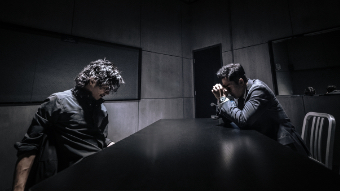
Thanks to his backstory, Tse delivers a villainous performance that is both intriguing and, at times, over-the-top. Whether due to uneven writing or distracting Mandarin dubbing, his character never fully achieves the psychological depth it strives for. Still, Tse brings intensity to the role, particularly in an interrogation scene with Bong that echoes The Dark Knight, with Yen channeling a furious, unmasked Batman opposite Tse’s chaotic adversary.
As expected, Raging Fire is packed with shootouts and action sequences typical of a Benny Chan production. The choreography credited to Yen’s stunt team, including Kenji Tanigaki, Ku Huen Chiu, and Nicky Li is ultimately a mixed bag. Perhaps due to too many creative voices, the action lacks the memorable impact seen in films like Firestorm and Cold War, both choreographed by Chin Kar-lok.
Although the marketing heavily teases a showdown between Yen and Tse, their long-awaited hand-to-hand clash only arrives in the finale and it feels merely serviceable. It’s hard not to compare it to the iconic alley fight in SPL: Sha Po Lang featuring Yen and Wu Jing. Similarly, a climactic gun battle set in crowded Tsim Sha Tsui fails to surpass the spectacle of Firestorm, particularly the memorable sequence involving Andy Lau. An earlier motorcycle chase between Bong and Ngo also feels underwhelming, ending in a way that borders on implausible. Even a hard-hitting fight between Yen and veteran actor Ben Lam, while solid, fails to stand out. Despite the film’s abundance of action, quantity ultimately does not equal quality.
As much as one might want to give Raging Fire a four-star rating in honor of Benny Chan’s final contribution to cinema, the film doesn’t quite earn it. While it’s not as muddled as Divergence or as cheesy as The White Storm, it pales in comparison to recent efforts by younger Hong Kong directors tackling similar themes. Ultimately, Raging Fire feels undercooked and overly familiar—a respectable but disappointing farewell. One can’t help but wish for a stronger story and more memorable action.
Movie Rating:

(Benny Chan and Donnie Yen knows action. Enough said if you are an action fan of HK cinema)
Review by Linus Tee
You might also like:
.jpg)
Movie Stills