


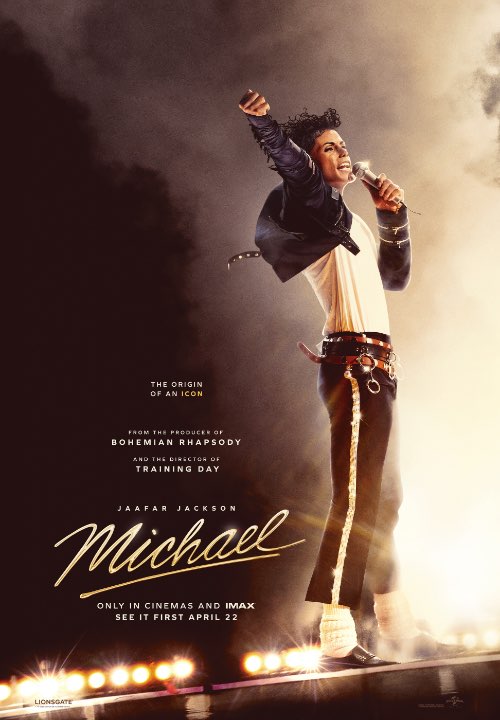
MICHAEL (2026)
Genre: Drama/Biography
Director: Antoine Fuqua
Cast: Jaafar Jackson, Nia Long, Laura Harrier, Juliano Krue Valdi, Miles Teller, Colman Domingo
Runtime: 2 hr 7 min
Rating: PG
Released By: UIP
Official Website:
Opening Day: 23 April 2026
Synopsis: MICHAEL is the cinematic portrayal of the life and legacy of one of the most influential artists the world has ever known. The film tells the story of Michael Jackson’s life beyond the music, tracing his journey from the discovery of his extraordinary talent as the lead of the Jackson Five, to the visionary artist whose creative ambition fuelled a relentless pursuit to become the biggest entertainer in the world. Highlighting both his life off-stage and some of the most iconic performances from his early solo career, the film gives audiences a front-row seat to Michael Jackson as never before. This is where his story begins.
Movie Review:
Biopics often walk a fine line between truth and tribute, and Michael, directed by Antoine Fuqua, makes its stance clear from the outset. As a film approved by the Michael Jackson Estate, it was always expected that the more controversial aspects of Michael Jackson’s life — the allegations, health struggles and well-documented family tensions — would be softened or omitted. What audiences are given instead is a carefully curated portrait, one that leans firmly into celebration rather than scrutiny.
Approached with that understanding, the film becomes easier to engage with on its own terms. Rather than attempting to dissect the complexities of Jackson’s life, it focuses on what defined his global legacy: the music.
The narrative traces his journey from his early days with the Jackson 5 to his rise as a solo phenomenon, culminating in his electrifying performance at Wembley Stadium during the Bad Tour in 1988. It’s a structure that prioritises momentum and nostalgia, charting the milestones that turned Jackson into the “King of Pop.”
For fans, the musical sequences are the film’s undeniable highlight. Iconic tracks like I'll Be There, Beat It, Thriller, and Billie Jean are staged with energy and reverence, designed to transport audiences back to the height of Jackson’s cultural dominance. Watching these sequences in an IMAX theatre only amplifies the experience — the booming sound system and expansive screen create something that feels closer to a live concert than a traditional film. In many ways, Michael functions as a concert film on a grand cinematic scale.
Central to its success is Jaafar Jackson, who steps into the role of his uncle with remarkable commitment. His performance goes beyond imitation; he captures the physicality, vocal style, and stage presence that made Michael Jackson a phenomenon. There is a palpable sense of dedication in every movement, and it’s difficult not to be swept up in the sheer effort and passion he brings to the role. It’s the kind of performance that invites applause, particularly during the film’s biggest musical moments.
Supporting performances add further texture. Nia Long brings warmth and quiet resilience as Katherine Jackson, portraying a mother who endures and supports amidst the pressures surrounding her family. Meanwhile, Colman Domingo is compellingly intense as Joe Jackson, depicted here as a domineering and often intimidating figure. Domingo commands attention whenever he appears, embodying a presence that is both authoritative and unsettling.
Of course, the film’s greatest limitation is also its defining choice. By glossing over the more troubling chapters of Jackson’s life, it sacrifices depth for accessibility. Those hoping for a more probing, unfiltered exploration may find it lacking. But for others — particularly fans — this approach may feel appropriate, even welcome.
Michael is less an examination and more a celebration. It may not tell the full story, but as a tribute to one of music’s most influential figures, it delivers an experience that is polished, nostalgic, and undeniably entertaining.
Movie Rating:


(A polished, crowd-pleasing biopic that celebrates the music while sidestepping the controversy)
Review by John Li
You might also like:
Movie Stills


