

THE UPRISING (2026)
Genre: Drama/War
Director: Paul Greengrass
Cast: Andrew Garfield, Jamie Bell, Stephen Dillane, Tom Hollander, Cosmo Jarvis, Thomasin McKenzie, Jonny Lee Miller, Woody Norman, Katherine Waterston, Sky Yang
Runtime: 2 hr 8 mins
Rating: NC16 (Violence)
Released By: Shaw Organisation
Official Website:
Opening Day: 17 September 2026
Synopsis: Andrew Garfield stars as the legendary leader of a ferocious rebellion against the tyranny of King Richard II. As war burns across England, he forms an army of the people to face the King's might in a fight for justice and survival.
Movie Review:
Paul Greengrass gave the spy thriller a welcome jolt of life with his 'Bourne' films. His restless camera, abrupt cuts and sense of barely controlled chaos made the action feel immediate and dangerous. In 'United 93' and 'Captain Phillips', that same cinéma vérité style brought an extraordinary urgency to real events, putting us alongside ordinary people confronting unimaginable circumstances. On paper, the Peasants’ Revolt of 1381 seems an equally promising subject for a filmmaker so adept at making history feel like the present.
Set in an England ravaged by plague and squeezed by taxation, 'The Uprising' has no shortage of contemporary resonance. Its account of an aggrieved population turning against a privileged ruling class offers poignant parallels with the inequality unsettling societies and politics today. Unfortunately, relevance alone cannot sustain a movie. For much of its overindulgent two hours, Greengrass’s latest is an unengaging, uninteresting and increasingly frustrating affair, full of commotion but curiously short of dramatic life.
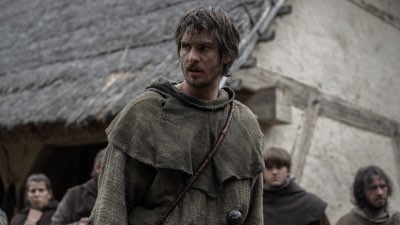
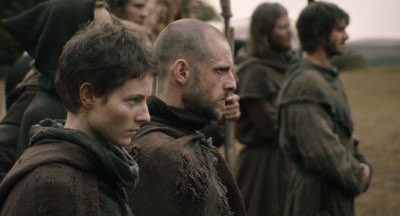
Andrew Garfield plays an unnamed Ploughman who has lost his wife and children to the plague. When brutal tax collectors descend on his village, his intervention to protect a neighbour draws him into a growing rebellion. Alongside Wat Tyler (Cosmo Jarvis) and the radical priest John Ball (Jamie Bell), he joins a march on London, where the peasants hope that the young Richard II (Woody Norman) will hear their grievances and grant them justice. Crucially, their anger is directed at those governing around him; they still believe the monarch himself might be persuaded to act on their behalf.
Meanwhile, the king’s advisers seek to preserve their own privileges by extracting more from people who have little left to give. The conflict is clear enough. What is missing is any sustained interest in the world that has produced it, or the individuals caught within it. Greengrass supplies the broad causes of the revolt, but little sense of how its participants live, think or differ from one another.
Instead, he stages much of the uprising with the clinical detachment of a documentary observer, moving between confrontation, mobilisation and court intrigue. We witness events without becoming particularly invested in them. The peasants’ fury is understandable, but the film keeps restating that fury when it ought to be deepening our understanding of the people expressing it. The storytelling is threadbare, with grievance too often standing in for character and escalation mistaken for development.
Garfield works hard to give the Ploughman an inner life. His sorrowful face suggests a man whose capacity to endure has finally run out, and there are affecting exchanges with Thomasin McKenzie’s fellow rebel. Yet the screenplay gives him so little to work with that his silence gradually becomes a limitation. We know what he has suffered; we seldom discover much about who he is beyond that suffering.
The approach fares better in a couple of brutal action sequences. Here, Greengrass’s shaky camera conveys the terror and confusion of bodies colliding, weapons swinging and crowds slipping beyond anyone’s control. The violence is ugly and immediate, with none of the comfortable distance of a stately historical epic. These passages briefly give the film the urgency it otherwise struggles to find, although repeated bloodshed eventually becomes numbing.
There are, to be fair, moments that reach past the spectacle. The Ploughman’s personal plea to the king to spare the villages and their people is especially moving. Garfield finds a simple, wounded humanity in a man trying to explain that those being punished were only asking for justice. For once, the political argument acquires a recognisable human voice, and the film gives us a reason to care beyond agreeing with its sympathies.
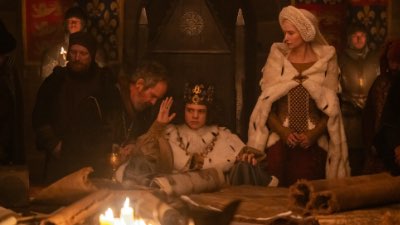
Richard’s betrayal is similarly painful. Norman conveys the insecurity beneath the crown, while Katherine Waterston, playing his mother, brings feeling to her efforts to steer him towards compassion. The sadness lies in watching a frightened boy choose cruelty as a means of asserting authority. There is tragedy, too, in the rebels’ anger hardening into vengeance, as legitimate demands become entangled with bloodlust and violence produces another round of violence.
These scenes suggest a more involving film about grief, power and the destruction of hope. Unfortunately, they arrive too intermittently to overcome the prevailing emotional distance. Across two hours, the succession of marches, clashes and scheming feels more repetitive than cumulative.
By the time its epilogue turns the Ploughman towards a familiar outlaw legend, 'The Uprising' effectively reveals itself as an unabashed 'Robin Hood' prequel. It is a peculiar reward for a film that has struggled to make its own protagonist compelling. Greengrass has found a historical tragedy with plenty to say to the present, but does both his material and his audience few favours. For all its righteous anger and bloody spectacle, this is a largely uninvolving affair that leaves us disengaged and disappointingly unmoved.
Movie Rating:


(Despite its timely themes and brutal action, Paul Greengrass’s 'The Uprising' is undone by threadbare storytelling that leaves us largely disengaged and unmoved)
Review by Gabriel Chong
You might also like:
.jpg)
Movie Stills