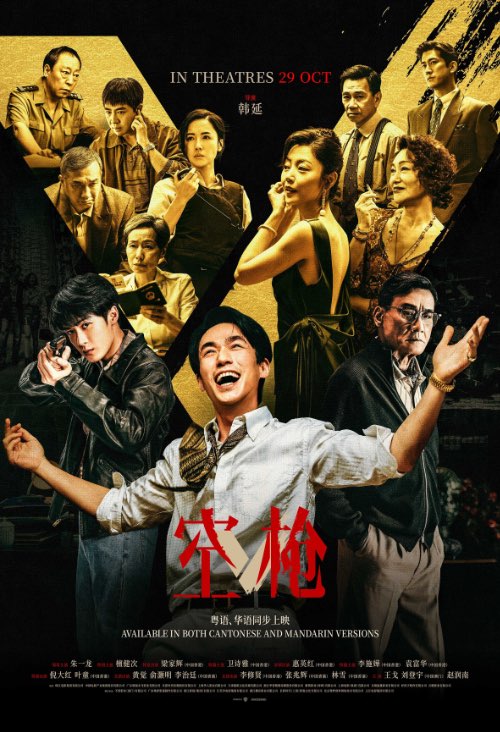


V (空枪) (2026)
Genre: Crime/Thriller
Director: Han Yan
Cast: Zhu Yilong, Tan Jianci, Leung Ka Fai Tony, Michelle Wai, Kara Wai, Selena Lee, Ben Yuen, Ni Dahong, Cecilia Yip, Aarif Lee, Eddie Cheung, Lam Suet, Danny Lee
Runtime: 2 hr 40 mins
Rating: M18 (Violence and Some Coarse Language)
Released By: Shaw Organisation
Official Website:
Opening Day: 29 October 2026
Synopsis: In the early 1990s, this city of desire, once "paved with gold", had fallen into a state of broken order and rampant crime. Worker Man Zi-Keung (Zhu Yilong) is determined to rewrite his fate. After meeting flight attendant Lok Ka-Yuen (Michelle Wai), the two join forces to commit a heist, seizing a huge sum of money. This success drives Man Zi-Keung to greater extremes, pushing him and businessman Chan Fai-Yin (Leung Ka Fai Tony) deeper into a vortex of escalating confrontation. Meanwhile, the mainland police officer Qi Honggang (Tan Jianci) and Hong Kong police officer Kwan So-San (Selena Lee) join hands in investigating Man Zi-Keung. The clash between good and evil is on the verge of eruption...
Movie Review:
Over almost three hours, writer-director Han Yan unfurls a sprawling crime epic inspired by Cheung Tze-Keung, the notorious Hong Kong gangster known as ‘Big Spender’, whose high-profile heists and billionaire kidnappings made headlines in the 1990s. His fictional counterpart here is Man Zi-Keung (Zhu Yilong), a Haidong immigrant who arrives in pre-handover Hong Kong determined to make his fortune by hook or by crook. For inspiration, he looks to tycoon Chan Fai-Yin (Tony Leung Kar Fai), whose rags-to-riches success embodies everything Man covets — and whose wealth will eventually make him a target.
At the heart of Man’s audacity is his conviction that he controls his own fate. Miraculously surviving a game of Russian roulette with corrupt OCTB senior inspector Wing (Ben Yuen) gives him an inflated sense of his own invincibility. The film will eventually expose the hollowness of that formative encounter, but Man has already built his identity around it. Even when his increasingly disillusioned wife Lok Ka-Yuen (Michelle Wai) reminds him that he was holding an ‘empty gun’ — hence the Chinese title ‘空枪’ — he refuses to relinquish the myth. That self-belief propels an increasingly brazen criminal career, from an elaborate airport heist to the kidnapping of Chan’s son (Aarif Lee), and finally a threat to blow up Hong Kong’s Qing Yi Port.
These three episodes anchor the film’s three acts, which Han drives forward with vigorous, often exhilarating momentum. Only towards the end does the pace slacken, as Man’s exploits give way to his mounting grievances against a system he believes the wealthy have built for their own benefit. Oh yes, the social commentary is hardly subtle: Chan wears a modest $700 watch while keeping a roomful of expensive timepieces at home, and Man appeals to working-class resentment to enlist others in his crime spree. Yet there is a revealing contradiction in his indignation. He rails against the privileges of the rich while craving a place among them, and the further he goes, the harder it becomes to distinguish solidarity with the downtrodden from wounded entitlement.
That contradiction gives Zhu plenty to work with, and he is magnetic as the larger-than-life criminal. His Man can be charming, menacing and utterly ruthless, sometimes within the same scene, and Zhu keeps those qualities in a volatile balance. Love him or hate him, you can scarcely take your eyes off him. More impressively, Zhu makes it difficult to dismiss Man as a straightforward villain. When he stands up for his fellow Haidong brothers or punctures the complacency of the powerful, we might even find ourselves rooting for him, despite knowing how readily his defiance can turn destructive.
The film is less successful at developing an equally compelling figure on the other side of the law. Haizhou provincial police officer Qi Honggang (Tan Jianci) doggedly pursues Man, eventually joining forces with Hong Kong detective Susan (Selena Lee). His commitment to justice provides an obvious counterpoint to Man’s increasingly self-serving worldview, but the relationship generates less friction than it should. A late coda attempts to lend greater significance to Man’s fascination with Qi and his desire to recruit him as a partner in crime. By then, however, the film has done too little to make that fascination convincing. Between the character’s unwavering rectitude and Tan’s earnest performance, Qi never quite becomes the compelling foil that Man needs.
Much the same frustration applies to Man’s complicated relationship with Lok. Wai makes a strong impression in the first act, but the force of those early scenes dissipates as her character gets swept aside by the succession of schemes, confrontations and reversals. That is a pity, because Lok is the closest Man has to a moral compass, and her growing disillusionment could have given his descent greater emotional weight. Wai does what she can with the role; we wish the film had afforded her more opportunities to challenge the man behind the swagger.
We would likewise have welcomed more of the interplay between Man and Chan, if only to give Leung a larger part in the proceedings. In what amounts to an extended cameo, the veteran actor makes a formidable impression as a tycoon who recognises the unhinged megalomaniac before him and refuses to be intimidated. His composure offers a particularly satisfying response to Man’s bluster. Here, at last, is someone whose authority Man cannot simply overwhelm, and their encounters suggest how much more the film might have gained from letting its characters confront one another at greater length.
Indeed, for a film running close to three hours, ‘V’ can be surprisingly impatient with its own dramatic possibilities. Han keeps the narrative moving at such a rapid clip that there is barely time to absorb one development before the next arrives. There is nary a dull moment, but the most engrossing passages are those in which he allows a situation to unfold properly: the elaborate mechanics of the airport heist, for instance, or the search for Chan’s son while the tycoon gathers the ransom. These sequences give suspense room to build, demonstrating how much the film can achieve when its energy is concentrated rather than scattered across another flurry of incidents.
Still, ‘V’ is a glorious throwback to the propulsive storytelling of 1990s Hong Kong cinema, with the ambition, bravado and larger-than-life personalities to match. Its portrayal of pre-handover Hong Kong sometimes feels filtered through the expectations of mainland censorship, but the nostalgia for the city’s freewheeling spirit is unmistakable. Beneath its account of one criminal’s rise and fall lies a fascination with a place where the promise of reinvention could inspire extraordinary enterprise and monstrous ambition alike. Uneven as it may be, Han’s sprawling epic recaptures something of that intoxicating energy — and in Zhu, it has a star more than capable of carrying us through its excesses.
Movie Rating:


(An exhilarating throwback to 1990s Hong Kong crime cinema, ‘V’ is powered by Zhu Yilong’s magnetic performance, though its relentless pace short-changes the supporting characters)
Review by Gabriel Chong
You might also like: