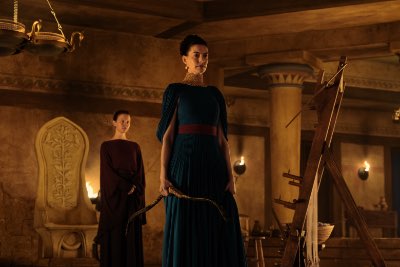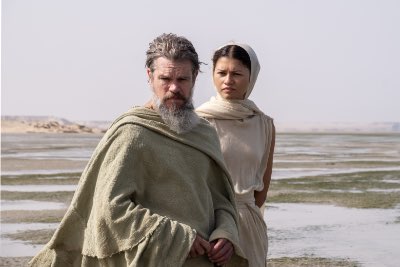


THE ODYSSEY (2026)
Genre: Action/Fantasy
Director: Christopher Nolan
Cast: Matt Damon, Tom Holland, Anne Hathaway, Robert Pattinson, Lupita Nyong’o, Zendaya, Charlize Theron, Elliot Page, Jon Bernthal, Himesh Patel, Mia Goth, Samantha Morton, Corey Hawkins, Benny Safdie, Logan Marshall-Green, Will Yun Lee, Ryan Hurst, John Leguizamo
Runtime: 2 hr 52 mins
Rating: NC16 (Violence)
Released By: UIP
Official Website:
Opening Day: 16 July 2026
Synopsis: The Odyssey follows Odysseus, the legendary Greek king of Ithaca, on his long and perilous journey home following the Trojan War, chronicling his encounters with mythical beings while attempting to reunite with his wife, Penelope.
Movie Review:
(This review is based on the film's 35mm presentation)
When it was first announced that Christopher Nolan would be adapting The Odyssey, cinephiles understandably rejoiced. After all, this is the filmmaker who has continually demonstrated that large-scale cinema can be both intellectually stimulating and commercially successful, whether through the mind-bending narratives of Inception (2010), the time-bending spectacle of Interstellar (2014), or the Oscar-winning historical drama Oppenheimer (2023).
If anyone could bring one of the oldest surviving works of literature to modern audiences, Nolan seemed like the perfect choice.
Then came the internet discourse. Social media quickly filled with complaints about the star-studded casting, while trailers drew criticism for their contemporary-sounding dialogue and accents that some deemed historically inaccurate.
For a brief moment, there was reason to wonder whether Nolan had finally overreached. Those fears, however, prove to be little more than online noise. Sitting through the film's nearly three-hour runtime, this reviewer remained captivated from beginning to end.
Based on Homer's epic poem, The Odyssey follows the long and arduous journey of Odysseus as he struggles to return home after the Trojan War. Along the way, he encounters mythical creatures, hostile rulers, supernatural temptations and impossible trials, while back in Ithaca, his faithful wife Penelope and son Telemachus endure growing uncertainty as opportunistic suitors threaten their home and kingdom.
What immediately distinguishes Nolan's adaptation is his masterful command of storytelling. Rather than presenting events in straightforward chronological order, the narrative moves fluidly between locations and timelines.
Yet unlike lesser films that employ non-linear storytelling as a gimmick, every shift here serves a purpose. Each sequence enriches the emotional journey, and nothing feels as though it merely exists to pad the runtime. The structure keeps viewers actively engaged, rewarding attention without becoming inaccessible.
The film also boasts an enormous cast of characters, and remarkably, Nolan finds humanity in almost every one of them. While some naturally command greater emotional investment than others, this reviewer certainly did not expect to feel sympathy for the Cyclops or even Circe the witch.
Yet Nolan's storytelling grants them enough emotional depth that they become far more than mythical encounters. They feel like characters with their own histories, motivations and vulnerabilities, making the world of The Odyssey all the richer.
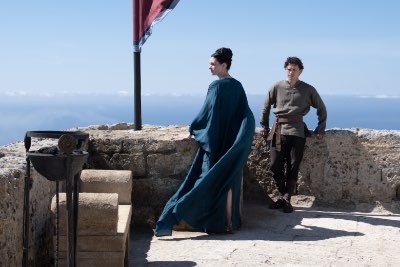
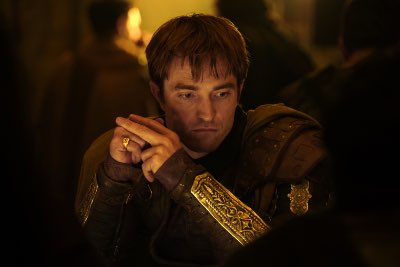
As expected from a Christopher Nolan production, the cast resembles a showcase of Hollywood's finest. Charlize Theron and Zendaya bring remarkable screen presence whenever they appear. Anne Hathaway delivers one of the film's strongest emotional performances as Penelope, conveying the loneliness and quiet resilience of a wife who has waited years for her husband's return. Tom Holland makes effective use of his youthful earnestness as Telemachus, while Robert Pattinson is deliciously detestable in a villainous role that audiences will relish despising.
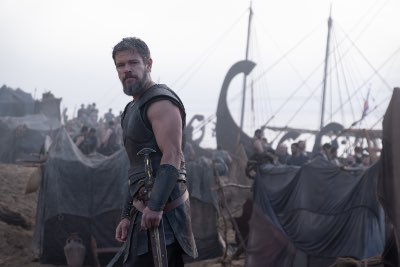
The film's emotional anchor, however, is Matt Damon as Odysseus. Damon makes viewers feel every ounce of physical exhaustion and emotional burden accumulated across years of wandering. One extraordinary scene near the conclusion, where Odysseus recounts what he has endured to Penelope, becomes a profoundly moving release of years of suppressed grief, regret and longing.
Visually, The Odyssey is nothing short of breathtaking, and its scale is matched by an extraordinary technical achievement. It is the first feature film in history to be shot entirely on 70mm IMAX film, with Nolan using newly developed, quieter IMAX cameras loaded with Kodak 65mm celluloid. The production reportedly consumed more than two million feet of film stock, with each magazine holding only around three minutes of footage before requiring a reload. Such limitations demanded meticulous planning and precision from the cast and crew, recalling the discipline of filmmaking in an earlier era.
The effort is richly rewarded on screen. Towering coastlines, storm-lashed seas, mythical creatures and intimate character moments all possess a breathtaking sense of scale and texture. Nolan seamlessly blends mythology, creature horror, action, psychological drama and deeply human emotion into one immersive cinematic experience, demonstrating once again that technical innovation is at its most impressive when it serves the story.
Equally essential is Ludwig Göransson's thunderous score, which transforms every sequence into a visceral sensory experience. Continuing his gift for crafting bold, rhythm-driven soundscapes, Göransson combines sweeping orchestral arrangements with primal percussion and haunting choral voices to evoke both the grandeur and mystery of Greek mythology.
This reviewer had the privilege of attending a 35mm preview screening — an especially meaningful occasion, as Singapore is the only country in Southeast Asia to host this analogue presentation.
Watching film projected rather than digitally displayed takes a few minutes to adjust to. The softer texture, subtle grain and organic imperfections initially feel unfamiliar in an age of razor-sharp digital imagery, but before long they become part of the immersion. There is a warmth and tactile quality that digital simply cannot replicate.
The 35mm screening did not feature subtitles, and it reminded this reviewer how accustomed we have become to reading while watching films. Here, every conversation demanded undivided attention, encouraging audiences to truly listen to the performances instead of subconsciously relying on text. It felt like rediscovering a small but important part of the cinematic experience.
The journey has been unforgettable, and this reviewer fully intends to experience it again in IMAX, even if Singapore unfortunately lacks an IMAX 70mm projector. Judging by the reaction at the preview screening, many Nolan fans will likely be making the same return voyage.
Movie Rating:


(Christopher Nolan transforms an ancient epic into a breathtaking cinematic odyssey — a technical marvel that reaffirms why he remains one of cinema's greatest visionaries)
Review by John Li
You might also like:
.jpg)

Movie Stills