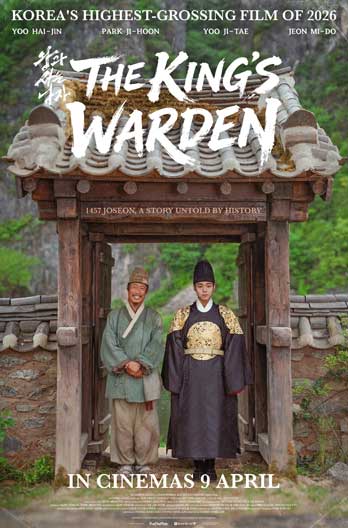


THE KING'S WARDEN (왕과 사는 남자) (2026)
Genre: Drama
Director: Chang Hang-jun
Cast: Yoo Hai-Jin, Park Ji-Hoon, Yoo Ji-Tae, Jeon Mi-Do
Runtime: 1 hr 57 mins
Rating: NC16 (Some Violence)
Released By: Golden Village
Official Website:
Opening Day: 9 April 2026
Synopsis: “Now, where am I to go…?” In the wake of a violent political coup that shakes the Joseon dynasty, King Yi Hong-wi is dethroned and sent into exile. “No matter what it takes, we must have him come to our village.” Meanwhile, in the remote mountain village of Gwangchungol in Yeongwol, village chief Eom Heung-do struggles to provide for his people. Hoping to revive the village, he volunteers Cheongnyeongpo as a place of exile, believing it will bring great fortune. However, the man he welcomes is not a powerful noble, but the young, dethroned king, Yi Hong-wi. Tasked as the warden responsible for the exile, Eom Heung-do must watch Yi Hong-wi’s every move. As days pass, however, he grows increasingly concerned by the boy who has lost the will to live. The story of Cheongnyeongpo, 1457, that history tried to erase.
Movie Review:
It’s a feat when a historical drama achieves both critical resonance and mass appeal, and The King's Warden has done exactly that. As the highest-grossing film and the third most-watched title in South Korean box office history, its success speaks volumes. Part of its immense popularity likely lies in its accessibility: it brings a lesser-known chapter of Korean history to life in a way that feels intimate rather than academic, emotional rather than distant.
The film centres on the deposed King Danjong, who, in 1457, was exiled after being removed from the throne. While many may be unfamiliar with this period of Korean history, the film smartly narrows its focus to the king’s domestic life in exile, portraying not grand political manoeuvres but the quiet, suffocating loneliness of a young ruler stripped of power. It is in this smaller, more human scale that the film finds its emotional strength.
Interestingly, The King’s Warden isn’t a sombre historical piece. There is a blend of comedy and drama, introducing a humble mountain village and its well-meaning but somewhat bumbling chief. Played by Yoo Hae-jin, the village leader goes to great lengths to shelter the exiled aristocrat, resulting in several genuinely funny moments. His earnestness, combined with the villagers’ curiosity and awkward attempts at hospitality, creates a lighthearted tone that draws audiences in with ease.
Running parallel to this is the more serious thread of the prince’s political predicament. Even in exile, danger lingers. There are moments of tension that remind viewers of the fragile position he occupies — a young royal caught in a web of power struggles far beyond his control. This balance between humour and suspense keeps the narrative engaging, preventing it from becoming overly heavy too soon.
As the story unfolds, the film settles into a warm and quietly moving rhythm. The relationship between the prince and the villagers deepens, particularly with the village chief. There is a gentle, almost pastoral charm in these interactions, as the prince begins to open up and experience a semblance of ordinary life. These moments have a sense of comfort and humanity, offering a glimpse of what could have been had history taken a different course.
However, this warmth makes the film’s eventual shift all the more devastating. Without giving too much away, the ending takes a sharp turn into sorrow, grounding the story firmly in historical reality. The emotional transition is handled with care, ensuring that the sadness feels earned rather than manipulative. By the time the credits roll, the earlier humour and warmth linger as bittersweet memories.
Performance-wise, Yoo Hae-jin is the emotional anchor of the film. He effortlessly moves between comedy and poignancy, making the audience laugh before quietly breaking their hearts. Park Ji-hoon, as the young prince, delivers a dignified and restrained performance. He captures the internal conflict of a boy forced into an impossible situation, conveying both vulnerability and quiet strength.
Ultimately, The King’s Warden succeeds as a human-centred historical drama. Rather than overwhelming viewers with grand spectacle, it chooses to tell a deeply personal story — one that lingers not because of its scale, but because of its sincerity.
Movie Rating:


(A historical drama that balances warmth and humour before giving way to a quietly powerful, bittersweet end)
Review by John Li
You might also like:
 copy.jpg)