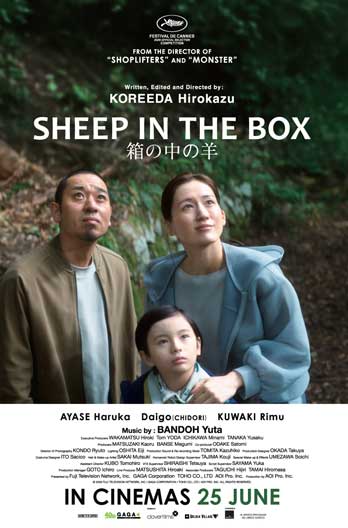


SHEEP IN THE BOX (箱の中の羊) (2026)
Genre: Drama
Director: Hirokazu Kore-eda
Cast: Daigo, Rimu Kuwaki, Ayase Haruka
Runtime: 2 hr 6 mins
Rating: PG
Released By: Golden Village
Official Website:
Opening Day: 25 June 2026
Synopsis: In the not-so-distant future, a grieving couple who has lost their son takes into their lives a humanoid with the same appearance and voice as their late child.
Movie Review:
The first Hollywood film that comes to mind while watching Sheep in the Box is Steven Spielberg's A.I. Artificial Intelligence (2001). Both films explore grief, memory and the human desire to hold on to loved ones who are no longer truly present. Both ask difficult questions about what it means to love someone, and whether technology can ever fill the void left behind by loss.
Yet while Spielberg approached those questions with overwhelming emotion and grand sentiment, this Japanese production chooses a markedly different path.
Viewers familiar with the works of Hirokazu Koreeda will immediately recognise that quieter sensibility. Rather than pushing audiences towards tears through dramatic confrontations or soaring speeches, Sheep in the Box invites contemplation through silence, stillness and patience.
Every frame feels carefully composed, every shot seemingly placed with precision and intention. The film gives audiences permission to simply sit with the characters and absorb the emotions lingering beneath the surface.
Written by Hirokazu Koreeda, the film centres on a couple left shattered by the loss of their child. Into that emptiness enters a humanoid companion that looks and behaves remarkably like a real child, offering the grieving parents an opportunity to reclaim a version of the life they once had.
Much like the premise of A.I. Artificial Intelligence, the story uses artificial life as a lens through which to explore grief, attachment and the lengths people will go to in order to hold on to those they love. Yet where Spielberg's film embraced grand emotion and spectacle, Koreeda approaches these ideas with intimacy and restraint. It would have been easy for the screenplay to lean heavily into emotional outbursts. One can imagine another version of this story filled with shouting matches, dramatic revelations and scenes engineered solely to make audiences cry. Instead, the film unfolds with remarkable restraint. Conversations are understated, glances often say more than words, and emotions are allowed to simmer rather than boil over.
That measured approach may not work for everyone, particularly viewers expecting conventional melodrama. Yet it is precisely this restraint that gives the film its emotional power. The quietness allows room for reflection, encouraging audiences to consider how they themselves might respond when confronted with impossible choices.
Parents are likely to find the experience particularly affecting. The themes explored here touch upon fears that sit deep within every family, and viewers who have experienced tragedy involving children may find certain moments especially difficult to watch.
The film never exploits those emotions, however. Instead, it approaches them with gentleness and compassion, treating grief not as spectacle but as something deeply personal and profoundly human.
As the narrative progresses, the story gradually edges towards science fiction territory. What initially appears to be an intimate family drama slowly opens into larger philosophical questions about identity, memory and what it means to let go. The transition is handled with elegance, never feeling jarring.
The finale, in particular, may surprise audiences expecting a more conventional conclusion. Rather than building towards catharsis through noise or spectacle, the film arrives at a place of serenity. There is sadness, certainly, but also acceptance. It is an ending that washes over viewers gently rather than overwhelming them.
Like much of Koreeda's best work, Sheep in the Box understands that cinema does not always need to shout to be heard. Sometimes the quietest stories linger the longest.
Movie Rating:


(Patient, thoughtful and quietly devastating, Sheep in the Box rewards those willing to surrender to its rhythm)
Review by John Li
You might also like: