


Genre: Horror/Thriller
Director: Lars Klevberg
Cast: Aubrey Plaza, Brian Tyree Henry, Gabriel Bateman, Tim Matheson, David Lewis, Beatrice Kitsos, Trent Redekop, Mark Hamill
Runtime: 1 hr 30 mins
Rating: M18 (Violence and Gore)
Released By: Golden Village Pictures
Official Website:
Opening Day: 11 July 2019
Synopsis: A contemporary re-imagining of the 1988 horror classic, Child's Play follows Karen (Aubrey Plaza), a single mother who gifts her son Andy (Gabriel Bateman) a Buddi doll, unaware of its more sinister nature.
Movie Review:
If you’re a fan of the Don Mancini series which continues to live on in direct-to-video sequels, chances are that you won’t much like this reboot that Mancini himself has denounced. Whereas the former revelled in campy fun and scares, this new ‘Child’s Play’ by Norwegian director Lars Klevberg and screenwriter Tyler Burton Smith feels utterly mechanical in its treatment of what is essentially a killer doll. Oh yes, other than being gory, there is hardly any fun to be had with this update, which perhaps deliberately chooses not to follow its cousins down the path of self-aware humour and ends up all the more poorer for it.
Frankly, we were disappointed the moment we saw this Internet-of-Things era version of Chucky. Instead of the battery-operated doll which was possessed via voodoo by the soul of a deranged psycho, Chucky is here an animatronic ‘Buddi’ that is supposed to be both its owner’s best buddy (get it?) and an Amazon Alexa-like gadget able to assist in your day-to-day tasks by controlling your home’s smart devices. There is no psycho here too, but rather the workings of a disgruntled employee at a sweatshop in Vietnam, who after being reprimanded and fired by his supervisor, decides to programme a chip without the usual violence-inhibiting functions for one of the ‘Buddi’ dolls, hence resulting in its proclivity for aggression.
Indeed, the conceit here is that Chucky learns his murderous tendencies, than inherits them, by watching such slasher movies as ‘The Texas Chainsaw Massacre 2’. As wry as that may be, it is far less compelling than the original – not only does it lack the personality of say the misogynistic killer whose murderous soul now inhabits the innocent-looking doll, this updated premise finds itself bereft of a reason why the doll would even call itself Chucky, simply dismissing it as something utterly random. It doesn’t help that the design of the ‘smart’ next-gen doll here hardly looks as adorable as the old Chucky, a key quality in emphasising the dichotomy between how he looks and how he behaves.
As with the original, Chucky finds his way into the hands of a widowed single mum, who then gifts it to her young son. Mom here is reconceived as Karen (Audrey Plaza), who works at a department store selling them Buddi dolls and is dating a cheating husband Shane (David Lewis). On the other hand, Andy (Gabriel Bateman) is an introverted kid with a hearing disability, who doesn’t get along at all with Sean and has a pet cat with a testy temperament that will (literally) be the death of it. Andy too befriends two kids on the block – Falyn (Beatrice Kitsos) and Pugg (Ty Consiglio) – who will come to his aid when the time calls for it, as well as a friendly African-American cop named Mike (Brian Tyree Henry) living next door with his mom.
Not surprisingly, each of these characters will take turns to have their fateful encounter with Chucky, whose raison d'être for murder evolves from its overprotectiveness of Andy to an overwhelming possessiveness over him. That relationship between Andy and Chucky has always been a pivotal dynamic in the film, given how it will come down to whether Andy manages to overcome his feelings of affection for his toy in order to save his loved ones, but that is somewhat muted here. Even as Andy’s reclusive nature sets him up nicely to develop a bond with his Buddi, we are never really convinced how much Andy really cherishes his animatronic companion, and therefore his eventual sense of resolve to stop Chucky once and for all.
If there is one thing which Klevberg’s version trumps over Mancini’s original, it is the gruesomeness of the murders, which includes death by tiller, death by mechanical buzzsaw and death by vicious stabbing. Oh yes, the violence is R-rated all right, and these scenes are staged such as to appeal to the sadistic crowd likely to cheer on the more inventively macabre they get. Granted that the ‘Child’s Play’ franchise had always played to these pleasures, but at least with the original and its sequels, the killings had the cover of being the work of a deranged individual who was anything but normal, an excuse which this reboot lacks.
Unless therefore you live vicariously through onscreen gore, there is little reason to check out this update of ‘Child’s Play’. Even for millennials who had not grown up with the original Chucky, the Mancini series is probably a better introduction to the infamous character than the reboot. Ultimately, it would have been better if the film had embraced its twisted origins, and gone for the same playful self-awareness which is the franchise’s very cult appeal. By draining that, and turning it into a slick slasher movie, it is just no longer as fun or as cruelly entertaining as it should be. Not everything updated to digital is better than its analog predecessor, and this modernised version of ‘Child’s Play’ is proof of that.
Movie Rating:


(Lacking the playful self-awareness of the original and its sequels, this reboot trades personality for slick displays of violence and gore, and is all the poorer for it)
Review by Gabriel Chong
Genre: Action/Crime
Director: Jazz Boon
Cast: Louis Koo, Nick Cheung, Francis Ng, Jiang Peiyao, Joe Ma, Huang Zhizhong, Zhang Yichi, Benjamin Yuen, Joel Chan
Runtime: 1 hr 38 mins
Rating: NC16 (Violence)
Released By: Clover Films & Golden Village Pictures
Official Website:
Opening Day: 8 August 2019
Synopsis: A frightening car crash in downtown Hong Kong sparks a war between the local police and the international criminal organizations. Superintendent Yip (Francis Ng) and Inspector Ching (Nick Cheung) from the Criminal Intelligence Bureau (Counter Terrorism) has arrested a female hacker named Yiu involved in the accident. But the two police officers are suspected by Superintendent Cheng (Louis Koo) of the Security Wing. Cheng requests the Commissioner of Police to forbid the two to take part in the investigation. Meanwhile, vital clues led them to the far foreign soil of Myanmar and Spain. Cheng and Ching work together but not hard enough to handle their conflicting ideas. While Yip just can’t trust neither one of them, he himself is being watched by the Commissioner who doubts if Yip is covering up evidences of crimes. The Commissioner believes that there have been moles in their midst and thus, a deep probe into a mysterious gang is needed. While everyone in the Police Force might be a rat, and investigation has gone astray by Yiu’s statements, heads of the department are completely clueless about who is good or evil.
Movie Review:
2016’s ‘Line Walker’ was intended as closure for fans of the TVB drama of the same name, but thankfully, ‘Line Walker 2’ doesn’t simply intend to be an epilogue of the subsequent TVB follow-up. Oh yes, together with screenwriter Cat Kwan, director Jazz Boon has decided to fashion a whole new story around similar themes of brotherhood, dual identities and loyalty, while retaining the original film’s star-studded cast of Nick Cheung, Louis Koo and Francis Ng. And indeed, this sequel is all the better for being associated with its predecessor only in name, for it is a much more compelling, poignant and thrilling film in its own right.
Here, Ng and Cheung play Superintendent Yip and Inspector Ching from the counter-terrorism branch of the Criminal Intelligence Bureau, who are assigned to investigate a suspected terrorist incident in Tsim Sha Tsui where a car had mowed down pedestrians in broad daylight and the driver had slashed his own throat thereafter. Their investigation leads them to independent journalist Yiu (Jiang Peiyao), who had called the police hotline before the incident warning of its imminence. Not only does both Yip and Ching manage to track Yiu down, they save her in the nick of time from a masked assassin looking to kidnap her.
Unfortunately, their subsequent interrogation is cut short by the sudden appearance of Superintendent Cheng (Louis Koo) from the Security Wing, who says he has the authority of the Commissioner of Police (Joe Ma) to take over jurisdiction of the case. That is however not before Yiu reveals that, in chasing a human trafficking story, she and her colleague had stumbled upon a powerful terrorist group which kidnaps children, trains them to be field agents and has used these agents to infiltrate police organisations around the world, including right there in Hong Kong.
That either Yip, Cheng or Ching could very well be working for the said terrorist group is teased unequivocally right from that point on; in particular, one of these three would have been a boy named Tsai in the opening prologue, who had been living in an orphanage in a village in Philippines back in 1987 before he was kidnapped by operatives from the group. That same prologue also establishes one of the trio would be Tsai’s best friend Ah Dee, who had been the target of the kidnappers before Tsai stepped in to save him and was taken instead. Further complicating their relationship is the fact that Yip had been mentor to Cheng and Ching, and even if the latter two do not trust each other, Yip is willing to vouch for them both.
Without giving anything away, let’s just say that who each of these characters are will be revealed midway through the film. As those familiar with the ‘Line Walker’ series will tell you, their identities are by no means synonymous with their loyalties, and indeed the last third explores just where their convictions lie. There is also a strong emphasis on brotherhood, not only between Yip and Cheng/ Ching for having mentored them, but also between Tsai and Ah Dee despite being separated for many years now. Their game of cat-and-mouse with one another, as well as with the larger terrorist group, will take them from Hong Kong to Myanmar and Spain, and the finale in fact unfolds in two locations at the same time.
Kudos to veteran TVB writer Kwan, who having honed her screenwriting skills in similar series such as ‘Lives of Omission’ (better known for ‘Laughing Gor’), constructs a sufficiently twisty narrative that doesn’t end up tying itself in unnecessary knots. It is also to her credit that the characters here are not lost amidst the swift plotting, and that each of the three key roles is defined not just by who they are but also what they believe in and are prepared to defend. All of this unfolds at a brisk clip within a very economical runtime of slightly over one-and-a-half hours, which makes for a thoroughly gripping watch from start to finish.
As with the previous film, ‘Line Walker 2’ enlists famed choreographer Chin Ka-lok as its action director, and there are at least two elaborate set-pieces here to shout about. One of these unfolds along the busy streets of Yangon in and around the iconic Shwedagon pagoda, and is absolutely exhilarating for its sheer display of firepower; the other takes place amidst the annual bull running festival in Spain, and besides the usual shootouts, stages a remarkable high-speed car chase along its streets with rampaging bulls. Ka-lok’s style emphasises authenticity, and the realism, clearly evident, only makes the spectacle even more astounding.
In the same vein, Ka-lok tailors his stunts to his performers, giving Cheung the chance to wow with a one-on-one close-quarter fight aboard a moving bus, as well as both Cheung and Koo to impress with their gunplay amidst an intense firefight in the middle of a busy thoroughfare. But of course, the real draw is watching Ng, Koo and Cheung bounce off one another with the chemistry of seasoned pros that know just how to complement each other; deserving of special mention is Koo, who in only his third film this year, has grown from strength to strength as an actor tackling multi-layered roles like this one here.
Just because of the sheer star power on display, ‘Line Walker 2’ is one of the must-see Hong Kong films this year. Like we said, Ng, Koo and Cheung each bring gravitas to their respective characters, and are simply magnetic to watch next to one another. In every other respect, the production values are strong and even outstanding, right from the very top with its confident directing and scripting, to the action choreography, and to its attention to locale-specific details. It is by far one of the better action thrillers out of Hong Kong in recent years, and we dare say enough to make us hope for another sequel in due course.
Movie Rating:
(Far better than its predecessor, this in-name only sequel retains the chemistry of its heavyweight cast for a gripping, even exhilarating, story of brotherhood, dual identities and loyalty)
Review by Gabriel Chong
Genre: Action/Adventure
Director: Shinsuke Sato
Cast: Kento Yamazaki, Ryo Yoshizawa, Nagasawa Masami, Kanna Hashimoto, Kanata Hongo
Runtime: 2 hrs 14 mins
Rating: PG13 (Some Violence)
Released By: mm2 Entertainment
Official Website:
Opening Day: 20 June 2019
Synopsis: Set during the warring states period in ancient China, Shin is a war orphan who dreams of becoming the greatest general under heaven. One day, he has a fateful encounter with a young man Eisei, the true heir to the Qin kingdom throne. Together, they seek to reclaim Eisei's throne and unite the Warring States under a single banner. KINGDOM is the live-action adaptation of the manga series of the same name.
Movie Review:
KINGDOM is a live-action adaptation of the manga series of the same name, which is a fictionalised story of Shin and Eisei (or better known to us as Qin Emperor aka Qin Shi Huang) during the warring states. This action adventure narrative follows Shin (played by Kento Yamazaki) and Hyou (played by Ryo Yoshizawa), who were sold as slaves to the same household. Despite being in a dire situation and environment, Hyou and Shin aspires to be the greatest general on Earth.
The film opens with Shin crossing path with Ouki, one of the greatest generals of their time, en route to the household that he was sold to. At that household, he found company in Hyou, who is also a fellow slave worker. The dynamics and bond between them was just as close as brothers, and they share the same dream of breaking out of their slave class by becoming the greatest general. Hence they spar with each other every day to develop and hone their swordsmanship, in hopes of achieving their dream. One fateful day, a general working for the emperor, Sho Bun Kun, encountered Hyou and wanted him to work for Qin. Hyou took up the offer, but only to land himself in a misfortune. He then came back to the village to look for Shin, and ordered him to look for Eisei.
The narrative of the movie is interesting as its story is somewhat based on Chinese history. Even for the uninitiated, the fictional story of the beginnings of how Eisei (Qin Emperor) wanted to rule the warring states was actually inspiring. This journey of Eisei reclaiming his throne from his half-brother was accompanied by Shin and Ka Ryo Ten (played by Kanna Hashimoto), and ally Yotanwa (played by Masami Nanagawa). The movie hardly has any dull moment, and has a great mix of sad and humorous scenes. The progress of the story was also easy to follow.
The character development and personality reveals were engaging and good too. The progress of how Shin grew from a stranger to being able to trust Eisei, and even supporting him in becoming the first king to unify the warring states was a great watch. The characters distinct and dynamic, with characters like Ouki (played by Takao Osawa) and Seikyo (played by Kanata Hongo) deserving a shoutout as well.
Even in the aspect of action choreography, this movie aced it. Both Kento Yamazaki and Ryo Yoshizawa nailed their respective roles. As Shin was self-taught, his actions are more freestyle, and are pretty unique. One of the highlights, as shared by Kento Yamazaki when he was in Singapore, would be Shin’s showdown with Saji (played by Sakaguchi Taku). The action sequence is coordinated by Yuji Shimomura, who was also involved in other manga-turned movies like Inuyashiki (2018) and Bleach (2018). On the other hand, Ryo Yoshizawa’s character Eisei’s moves are more refined, and Ryo’s 10 years in kendo definitely helped him to accomplish his role.
Both Kento Yamazaki and Ryo Yoshizawa showed agility and flexibility as actors, not only with regards to action, but in acting as well. Kento might be more known for the typical Shojo manga male lead roles like in Wolf Girl and Black Prince (2016) and One Week Friends (2017), but his role as Shin totally broke away from that mould. It’s almost unbelievable that this is his first proper action movie role. Ryo Yoshizawa, who plays two roles in the movie, also excelled. One of the highlights which showcases his acting is when Hyou meets Eisei. He plays both characters, and it seems almost effortless for Ryo to be snapping into the two different personalities, with the change of expression in his face and eyes.
What’s lacking though, was the CGI. In one of the chase scenes with the army riding on horses, the CGI simply made it look like a cheap production, and came across as cheesy. There were also some transitions between scenes which looked weird and awkward, e.g. bottom left corner to top wipes. This two-month long shoot shot in Japan and Xiangshan Film and Television Town in China, had many picturesque scenes though.
While it’s not that all perfect, it’s not often to see a movie with so many likeable characters and a good enough villain, owing to the great casting! Coupled with the onscreen chemistry between Eisei and Shin (it’s in fact Ryo and Kento’s fourth time working together!), there is nothing not to like!
Movie Rating:
(So good that you’ll wish for a sequel by the end of the movie!)
Review by Tho Shu Ling
Genre: Horror/Thriller
Director: Jit Kamnoedrat
Cast: David Chatchavan Asavanond, Sonthaya Chitmanee, Phurada Kongpech Mayor, Raiwin Ratsaminiyomwut, Chinawut Indracusin, Wanpiya Oamsinnoppakul, Tana Chatborirak, Nutchaphat Wongsuwan, Auttarut Kongrasri, Nimit Lugsamepong, Kittisak Vejprasan
Runtime: 2 hrs 5 mins
Rating: M18 (Sexual Scenes and Horror)
Released By: mm2 Entertainment
Official Website:
Opening Day: 25 July 2019
Synopsis: Three terrifying stories about curses. A pastor visits a isolated village said to be under a terrible curse, but discovers a horrible truth instead. A young woman discovers a cruel curse has been tattooed onto her skin and seeks the help of a renowned tattoo artist. A cartoonist wakes up with a head injury and finds himself haunted by a mysterious woman.
Movie Review:
Divided into three chapters, Curses is a Thai horror title that either wants to follow the footsteps of the 2008 cult-classic 4bia with its segments, or it ran out of material and tried to string the shorts together. I’m betting the latter half.
Cursesis not a bad film per se when it comes to intentions. Themed with the title in mind, a well-positioned venomous wish, especially when done in the moment of death, can make the best of us pee in our pants. And we all know what they say about Thai curses…
But director Jit Kamnoedrat is not going very far with the material. Curses is more Tales from the Crypt than The Twilight Zone, and fails to nail any sort of pay-off when the chapters finish. The morality lesson is quickly picked up within 10 minutes, and the characters are just excruciatingly moving towards a predictable ending.
With “Wicked”, we have an Anthony Wong look-alike priest, who investigates a performance troupe that has disappeared in a cursed village. Set during the reign of King Rama VI, the Thai stage play is an atmospheric set-up, but the story weaves out of control when the Father tries to save the day. Plagued with too much twists for its own good and an unnecessarily complicated plot, the story would have worked better if it dealt more with the mother-daughter relationship, or displayed more bullying from the village itself.
Then comes “Tattoo”, a story about a girl who seems to lose every guy she meets to some tragedy. Turns out, her ex-lover who also is an ink artist, has placed a curse in his work and sealed it into her body when he designed a tattoo for her. While refreshing in its angle, the love between the girl and her newest paramour is both weak and sudden, and so the emotional tug is nowhere to be found when the body count stacks up.
The last segment is “Wife’s Curse”. Our make lead wakes up to hauntings and strange happenings, and memory lapses add a further cloud on his sanity. Stricken with a deluge of incidents, he finally falls into a coma and his friends rally to save him. But from what, and whom? Turns out that the old saying about “hell hath no fury like a woman scorned” is demonstrated here fully, as a jealous and spiteful girlfriend places a curse in a fit of jealousy and rage. The sequence is extremely limp, and the result is an uninspiring mess.
Of the three, the last segment has to be the most tedious to watch. With repetitive but irrelevant scares thrown in and dismal acting, the characters are as unlikeable as they are unbelievable. In fact, this pretty much applies to the whole film. Curses is itself afflicted by a cast that doles out cheesy or deflate acting, and scares are more laughable than heart-stopping. I won’t be surprised if you leave the cinema cursing yourself.
Movie Rating:
(Simpering stories and weak acting make for a tedious watch. The theme may be potent but the plots don’t do justice)
Review by Morgan Awyong
Genre: Drama/Biography
Director: Farhad Safinia
Cast: Mel Gibson, Sean Penn, Natalie Dormer, Ioan Gruffudd, Eddie Marsan, Jeremy Irvine, Steve Coogan, Jennifer Ehle
Runtime: 2 hrs 5 mins
Rating: PG13 (Some Disturbing Scenes)
Released By: Shaw Organisation
Official Website:
Opening Day: 11 July 2019
Synopsis: The compilation of the Oxford English Dictionary began in 1857 and was one of the most ambitious, and revolutionary projects ever undertaken. Based on the worldwide bestselling novel by Simon Winchester, THE PROFESSOR AND THE MADMAN is an extraordinary true tale of madness, genius, and obsession about two remarkable men who created history with the writing of the Oxford English Dictionary… Professor James Murray (Mel Gibson) took on the challenge of creating the most comprehensive dictionary ever compiled, by “crowd sourcing” the work. During the process, the committee, led by Professor Murray, discovered that one man, Dr. W.C. Minor (Sean Penn), had submitted more than ten thousand words. When the committee insisted on honoring him, a shocking truth came to light…
Movie Review:
If you’ve heard of the movie ‘The Professor and the Madman’, you’d probably have read about its legal tangles that have delayed its release three years after shooting wrapped. Not only has Mel Gibson disavowed the movie, despite it being a passion project for him when it was first announced, its writer and director Farhad Safinia has also had his name scrubbed from it, so much so that the credits read that one P.B. Shemran is its helmer. Yet for all that negative publicity, this chronicle of the unlikely friendship between a Scottish autodidact and a PTSD-suffering American war veteran that unfolded against the backdrop of the compilation of the Oxford English Dictionary is still an intriguing, even if not particularly inspiring, watch.
The said Scottish autodidact is Sir James Murray (Gibson), a self-taught man fluent in numerous languages who was appointed to take over the stalled editorship of the OED; but though formally awarded the position, James had to contend with the snobbery of Oxford’s elite, namely its board member Benjamin Jowett (Anthony Andrews) and his lackey Lyttelton Gell (Laurence Fox). The task at hand was a mammoth one – just consider that it eventually took 70 years for the OED to be completed, even as James estimated it would take him seven – and simply impossible to be accomplished by any number of assistants, so James decides to appeal to the public to write in with their contributions, i.e. to build a dictionary by democracy.
That request for volunteers happens to reach the US war veteran William Chester Minor (Sean Penn), imprisoned at Broadmoor psychiatric hospital for mistakenly murdering an innocent man whom he thought was chasing him. At the hospital, Minor is placed under the care of Richard Brayne (Stephen Dillane), whose experimental methods of invasive treatment were questionable to say the very least. But before Brayne decides to employ his methods on Minor, the latter is given a fair degree of privileges after saving a young guard’s life, which includes having access to countless books that he relies on to help James research the evolution of certain words in the 17th and 18th century.
On that premise alone, it isn’t difficult to guess why there was considerable interest to turn the novel by Simon Winchester, on which this movie is based upon, into a film. Besides the fascinating circumstances under which James and Minor came to make each other’s acquaintance, there is also potential for a deeply poignant finish, what with James personally fighting to get Minor released from detention. Even without knowing just how different Safinia’s own version of the story would be, we dare say the one presented onscreen is still compelling in own right, elucidating not just the bond that formed between the pair but also the moral quandary which James found himself in when confronted with how Minor was being treated.
Yet equally, this could have been a much stronger telling had the narrative focused itself more squarely on the two men; instead, it gets distracted portraying just how Minor ended up in his sad predicament, and his sincere wish to make things right with the widow of the man whom he had wrongfully taken the life of. In particular, much time is spent developing the animosity which Eliza Merett (Natalie Dormer) feels towards Minor, that slowly evolves into gratitude when Minor donates his pension to her to look after the kids, and finally into forgiveness and even love. As much as Eliza’s testimony had helped secure Minor’s release at the end, we’d much rather that the movie had focused more squarely on James and Minor, even if it means turning the picture into pretty much a two-hander between Gibson and Penn.
Thanks to both Gibson and Penn, there is hardly a dull moment in the film. Penn sometimes goes overboard screaming, trembling and pulsing the veins out of his neck but he is still compulsively watchable even when playing to the gallery. On the other hand, Gibson turns in a surprisingly restrained performance as James, always retaining his dignity even when those around him plot and scheme and connive. This is quite unlike the brash characters which we had grown up watching Gibson play, but it’s nice to see the once ‘Lethal Weapon’ star mellow and turn in a dignified late-career type act that nicely complements Penn.
So even if there certainly is room to strengthen the storytelling, ‘The Professor and the Madman’ still manages to be an engaging watch on the strength of the story per se. As tempting as the comparison may be, you’d be pleased to know that watching the story of how the OED came about is a lot more interesting than reading the OED itself. It’s somewhat unfortunate therefore that the movie has languished so long in ignominy; indeed, if the producers had a little more faith in both Gibson and Sarfinia, we suspect the reception would probably have been a lot less muted. Still, it is a well-acted prestige picture that is deserving of much more recognition, and if anything, watch it for the rare chance of seeing both Gibson and Penn together in the same movie.
Movie Rating:
(Ignore the bad press that came before it; there is a genuinely intriguing story here, as well as a pair of strong performances from Mel Gibson and Sean Penn, that make for a surprisingly fascinating watch)
Review by Gabriel Chong
Genre: Drama
Director: Ralph Fiennes
Cast: Oleg Ivenko, Adèle Exarchopoulos, Louis Hofmann, Sergei Polunin, Olivier Rabourdin, Raphaël Personnaz, Ralph Fiennes
Runtime: 2 hr 8 mins
Rating: M18 (Nudity and Sexual References)
Released By: Shaw Organisation
Official Website:
Opening Day: 27 June 2019
Synopsis: Ralph Fiennes' THE WHITE CROW was inspired by the book Rudolf Nureyev: The Life by Julie Kavanaugh. The drama charts the iconic dancer's famed defection from the Soviet Union to the West in 1961, despite KGB efforts to stop him. Fiennes directs from a script by David Hare (The Hours). Acclaimed dancer Oleg Ivenko stars as Nureyev, alongside Adèle Exarchopoulos as Clara Saint, and Fiennes as Russian ballet coach Alexander Pushkin. Also featured are ballet-world enfant terrible Sergei Polunin, Chulpan Khamatova, Olivier Rabourdin, Raphaël Personnaz and Louis Hofmann.
Movie Review:
If you know your ballet, you would probably have heard of Russian dancer Rudolf Nureyev, who while on his first European tour to the city of Paris, made the life-changing decision to defect from Russia and the Kirov Ballet at the Paris-Le Bourget airport in 1961. Had he not made that pivotal step at the age of 23, chances are that he would not have enjoyed the same success, mostly because he would either have died or spent his prime years in Russian prison. And so, in adapting Julie Kavanagh’s 2007 biography of Nureyev, director Ralph Fiennes and writer David Hare have chosen to focus on the events leading up to their subject’s sensational escape, instead of say trying to cram his entire life story into a two-hour feature film.
In pivoting the movie around Nureyev’s defection, Fiennes gambles that his audience would be interested to know why he would choose to do so in the first place, and although there is no way to know that answer for sure, we suspect that it gets close enough. Saving the last act for that nail-biting encounter, the preceding two detail the time Nureyev spent in Paris prior to those moments, in which he strikes up a close but never physically intimate relationship with Clara Saint (Adèle Exarchopoulos), whose high-profile late ex-lover happens to be the son of France’s minister of cultural affairs. Flirtations aside, Clara will play a significant part in facilitating his move to seek political asylum, proving that it helps to know someone in high places.
Yet Fiennes’ thesis here is that it isn’t just who he encountered and what he experienced in Paris that influenced his decision, it was equally Nureyev’s upbringing as well as his mercurial personality. So in between the present-tense action in Paris, the narrative intercuts flashbacks of his childhood years and his rigorous training in Leningrad. These formative years go a long way into illustrating the sort of person Nureyev is, an individual who is though born into authority felt compelled to stand up to it if in conflict with his own interest; in fact, it was this non-conformist streak that led him to storm into the headmaster’s office a few months into his training and demand that he be under the respected instructor Alexander Pushkin (Fiennes).
Though played by Fiennes with complete understatement, it is no overstatement that Pushkin was responsible for guiding Nureyev to apply his passion to technique, thereby moulding him into becoming a magnetic performer on stage. Somewhat distracting, even though true, is the uncomfortable dynamic between Nureyev and Pushkin’s wife Xenia (Chulpan Khamatova), as initiated by the former who invites the latter to stay with them following an unfortunate leg injury; and indeed, if we were to choose, we’d rather the film spend more time on his more consequential relationships, such as his attraction for fellow dancer/ roommate Yuri Soloview (Sergei Polunin) and his dalliance with German terper Teja Kremke (Louis Hoffman).
Truth be told, these episodes in Nureyev’s life are only compelling insofar as they lend context to his nature and motivations; otherwise, on their own, they are too fleeting to build up to anything substantive. But to Fiennes’ credit, the climax is grippingly staged, such that even though you already know the outcome, you’ll probably still be clinging to the edge of your seat watching how Nureyev was caught by surprise by the Kremlin’s decision to send him back to Moscow and the impromptu intervention by French dancer Pierre Lacotte (Raphaël Peronnaz) as well as Clara in rescuing him from certain oblivion. There is payoff all right, if you’d hang on past the intermittently engaging middle section.
Casting Nureyev would never have been easy – you’d either have to get a professional actor to do it and learn some basic steps, or get a professional dancer and have to teach him some basic acting skills – but Fiennes is extremely lucky to have found a natural in newcomer Oleg Ivenko. The Ukrainian dancer is simply magnificent to watch in the dancing scenes, and even if he may not look much like Nureyev in real life, Ivenko channels his character’s swagger and tempestuous persona beautifully. Fiennes too picks up Russian admirably to deliver all his lines in the language, and Exarchopoulos is effectively cast against type as the demure Clara, but this is Ivenko’s show through and through.
It is not often we get a film whose subject is ballet, and perhaps inevitably, some viewers may compare this with ‘Black Swan’. Arguably, the two films are artistically distinct in their own right, and while ‘Swan’ was deliberately exaggerated, this one aims for nuance and subtlety in most measure. As a movie about Nureyev, we’d say it’s more than worthy as an introduction into the person, though those looking for something more insightful will probably be disappointed. Still, its statement about his passion, as well as what he was willing to do to pursue and defend it, is unmistakable and in that regard, ‘The White Crow’ flies, even if it doesn’t soar.
Movie Rating:
(A suitably engaging exploration of Russian dancer Rudolf Nureyev's life-changing decision to defect from the Soviet Union, this biography takes flight with a mesmerising performance by Oleg Ivenko in the lead role)
Review by Gabriel Chong
Genre: Drama/Romance
Director: Zhou Tong, Dai Mengying
Cast: Vivian Sung, Song Weilong, Stella, Huang Junjie, Jin Shijie
Runtime: 1 hr 32 mins
Rating: PG
Released By: mm2 Entertainment
Official Website:
Opening Day: 27 June 2019
Synopsis: Opposites clash when spunky girl next door Lin Lin meets eccentric nerd Yuke. Despite being neighbours and schoolmates since childhood, Lin Lin and Yuke barely know each other. When the pair are both admittedinto the same u niversity, Lin Lin discovers that Yuke harbours a secret crush for campus beauty, Ruting. Ever the busybody, Lin Lin decides to matchmake Yuke and Ruting, only to find herself gradually falling for Yuke.
Movie Review:
It started with You Are The Apple of My Eye (2011). Eight years on, there must be investors out there who think that Taiwanyouth romance movies are cash cows. Why else would there be what looks like a derivation of successful predecessors like Our Times (2015). Cafe. Waiting. Love (2014) and Take Me To The Moon (2017)?
The filmmakers even made the decision to cast the same female lead as the abovementioned three titles.
Vivian Sung plays Zhou Lin Lin, a carefree and free spirited high school student who isn’t quite the A grader. Her nemesis comes in the form of the hardworking Fang Yu Ke (Song Weilong), a goody two shoes staying in her vicinity and studies late into the night. Lin Lin’s mother forces her to study till Yu Ke’s lights go off. Eventually, he tutors her and they both enter the same university. A third character in the form of the pretty Ru Ting (Stella Lin) enters the picture, and what you get is a fluffy love story between the three leads.
Just like comic superhero franchises, we believe this genre of Taiwan youth romance flicks is facing fatigue. As you sit through the 92 minute movie, nothing stands out particularly and you can predict almost every plot development. Boy and girl are loggerheads with each other, boy and girl resolve their differences and become friends, boy and girl go through an unnecessary misunderstanding because of a third party, boy and girl patch up and realise that they have always been meant for each other.
When the male lead makes his first appearance in nerdy glasses and braces, you also know he is going to transform into a dashing dude later in the movie.
The saving grace of this movie is, of course, its ensemble of good looking stars. If you aren’t tired of seeing Sung play a similar personality for the fourth time, then you’d think she fares pretty well in this movie. Her male lead doesn’t need to do much because like many actor models out there, Song’s perfect features are made for camera close ups. Lin’s demure and gentle ways make you wonder whether she is a princess in real life.
It is also nice to see veteran actor Jin Shijie (Brotherhood of Blades) take on the supporting role of a cold hearted animal husbandry tutor who does not love animals.
Yes, you read that right. The protagonists are enrolled into the university’s animal husbandry course, and it gives the movie an opportunity to include shots of animals, and in particular: cute, furry rabbits. When the tutor instructs the students to euthanise the adorable creatures, it is the perfect chance for the male and female leads to overcome the ordeal together, and bring them together as an item.
We aren’t sure whether you were expecting a more dramatic conclusion (At Café 6 comes to mind), but this movie delivers a story that is by the books. Not that it is a bad thing though, if you are looking for a stress free way to spend a lazy afternoon.
Movie Rating:
(It's nothing you haven't seen before, but if you are not tired of being in the company of good looking stars, then this fluffy romantic movie is for you)
Review by John Li
Genre: Horror/Comedy
Director: Jim Jarmusch
Cast: Bill Murray, Adam Driver, Tilda Swinton, Chloë Sevigny, Steve Buscemi, Danny Glover, Caleb Landry Jones, Rosie Perez, Iggy Pop, Sara Driver, RZA, Carol Kane, Austin Butler, Luka Sabbat, Selena Gomez, Tom Waits
Runtime: 1 hr 45 mins
Rating: M18 (Violence and Gore)
Released By: UIP
Official Website:
Opening Day: 18 July 2019
Synopsis: In the sleepy small town of Centerville, something is not quite right. The moon hangs large and low in the sky, the hours of daylight are becoming unpredictable, and animals are beginning to exhibit unusual behaviors. No one quite knows why. News reports are scary and scientists are concerned. But no one foresees the strangest and most dangerous repercussion that will soon start plaguing Centerville: The Dead Don't Die — they rise from their graves and savagely attack and feast on the living, and the citize ns of the town must battle for their survival.
Movie Review:
Let’s be clear here: You’ll either love this movie for all its cleverness (because you’re that savvy zombie genre fan - especially for Romero - and geeks out at inside references), or you’ll be like the rest of us - a little bored and cheated.
To say The Dead Don’t Die is indulgent is about 70% right. The only 30%? Only Jarmusch will know. This movie doesn’t follow any rules and usually when that happens, it signals a deep intent. Either that, or it’s just plain all out to have fun. I mean it has to be one or the other right?
Here, because the jokes don’t exactly land as they should, some must think it’s so incredibly clever that they don’t get it… and laugh anyway. At least from the way the person in front of me was overcompensating with his overly generous chortles, it sure seems so. Others who recognise the references but didn’t find it particularly rib-tickling, probably attempted an awkward chuckle.
Bill Murray and Adam Driver play cops in the small town of Centerville, doing their daily bit to the locals with their patrols. But large-scale polar fracking by commercial giants have tilted the earth off-axis, and the unnatural occurrences that ensue include the undead popping out of their graves.
The Dead Don’t Die inherits the cloak of socially-conscious entertainment from similar classics like Romero’s Dawn of the Dead, Edgar Wright’s Shaun of the Dead, or the more recent Zombieland by Ruben Fleischer. But while the others had the right dose of self-awareness and charisma, Jarmusch’s brand of deadpan and references feels out-of-touch and dated.
From a messaging standpoint, it’s superficial. Be it about wasteful materialistic pursuits, twisted Trumpism or environmental ignorance, there’s nothing here that’s not been said before. And while repetition in itself is not a sin, the representation here is about as subtle as an axe on the head.
So what about the easter eggs and cultural references? Yes, there’s enough nudge and wink moments here to fill a sorority house. But unless you are a veteran purist who has the classics on VHS (and has lived long enough in ‘merica), chances are most of them will fly by you. I admit, I’m one of them. It’s like how it is with inside jokes - the ones in on it giggle, but the rest of us are just annoyed.
The Dead Don’t Die does a disservice to the regular movie-goer. Jim Jarmusch may think his brand a legacy enough to make this into a self-gratifying vehicle, but the delivery - so full of easter eggs, meta jokes, breaking the fourth wall - go the route of rinse-and-repeat...about 20 minutes in.
So yes, that theme song bit was fresh. Swinton’s eccentricity is a lark. But notice how I have not used any of the characters’ name thus far? That’s because it’s what this movie is - a gathering of Jarmusch regular and fans (Tom Waits, Chloe Sevigny, Steve Buscemi, Danny Glover, Caleb Landry Jones, RZA, Larry Fessenden, Carol Kane, Iggy Pop, Selena Gomez) that pulls on the skin of a role and milks their appearance for its worth. It just feels like attending a star-studded Halloween party uninvited.
Movie Rating:
(The messaging is old. The execution clumsy. The cast disconnected. Jarmusch has seen sharper and funnier days in his filmography)
Review by Morgan Awyong
SYNOPSIS: JJ, aka John Shaft Jr. (Usher), may be a cyber security expert with a degree from MIT, but to uncover the truth behind his best friend’s untimely death, he needs an education only his dad can provide. Absent throughout JJ’s youth, the legendary locked-and-loaded John Shaft (Jackson) agrees to help his progeny navigate Harlem’s heroin-infested underbelly. And while JJ’s own FBI analyst’s badge may clash with his dad’s trademark leather duster, there’s no denying family. Besides, Shaft’s got an agenda of his own, and a score to settle that’s professional and personal.
MOVIE REVIEW:
Instead of rebooting and remaking an old franchise property, Warner Bros came up with an ingenious way of reuniting three generations of “Shaft” for the famous detective’s latest outing. So for the price of one, you get three “Shafts”, not a bad deal for Netflix who paid for international rights.
Raised by his mother Maya (Regina Hall) since he was an infant, JJ aka John Shaft Jr (Jessie Usher) has to enlist the help of his long estranged father when his childhood friend, Karim is suspiciously found dead. JJ’s father is none other than the legendary, street-smart private detective John Shaft II (Samuel L. Jackson reprising his role in the 2000 version directed by the late John Singleton). Together with Shaft II, JJ is ready to investigate the underbelly of Harlem and at the same time, unexpectedly rekindling his relationship with a father he has never knew.
So much has changed since the days of Blaxploitation cinema and likely director Tim Story (the man behind Fantastic Four, Barbershop and Ride Along) and his writers knew it. Thus instead of another gritty exploitative sequel, the modern-day audiences got themselves a father-and-son sort of buddy action comedy that is both lightweight and formulaic.
For a crime investigative flick, the writers sure know how to pepper up the story with a lot of promising themes. Let’s see, we have an Islamic cleric who might harbour some terrorism intention, there’s a shady Latina grocery shop owner, a drug rehab clinic that might be a front for a smuggling ring and finally, Shaft II’s long-time enemy, drug lord Gordito might have a hand in it as well.
Unfortunately, the movie spent too much time developing the relationship between Shaft II and Junior that there’s too little time left for crime. Other than a couple of serviceable shoot-outs with underdeveloped villains, we are mostly left entertained by Samuel L. Jackson’s pussy/dick jokes, f-bombs and his constant jabs at millennials. Richard Roundtree who portrayed the original Shaft character returns as Grandpa Shaft for the climax proving it’s never too crowded to have two cool cats onscreen.
It’s not compulsory to watch the original Shaft or the 2000 Shaft before you stream this version. As mentioned earlier, the new Shaft is an entertaining action comedy yet forgettable take on the classic character. Just a warning though, if you find stuff liked racism, sexism and misogyny kind of offensive then this flick should be avoided at all costs.
MOVIE RATING:
Review by Linus Tee
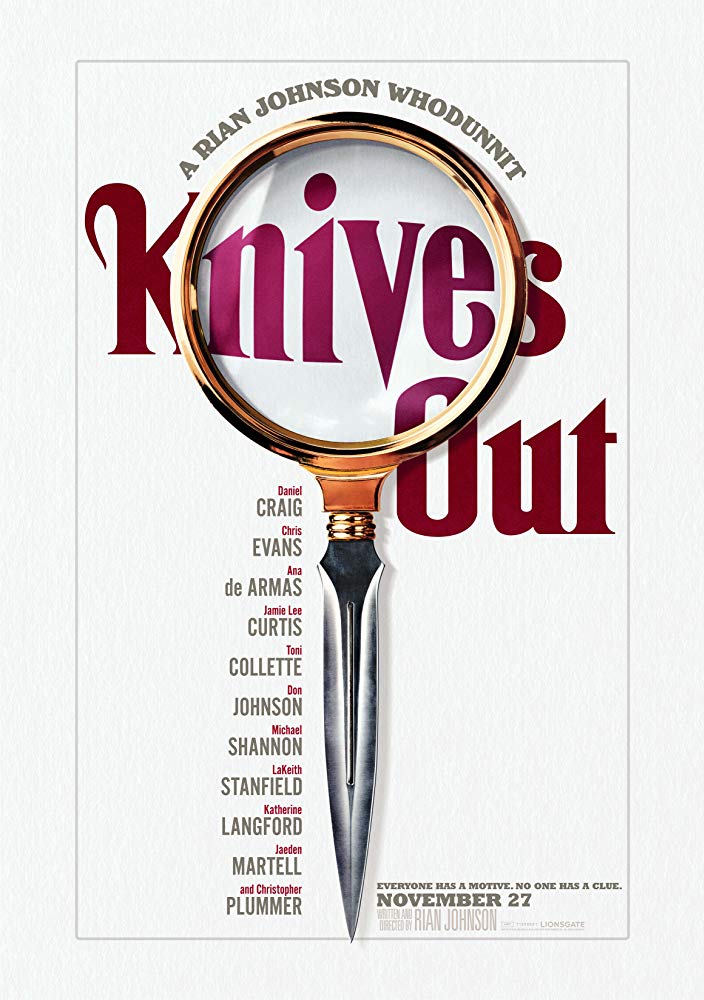
|
RIAN JOHNSON READIES AN AGATHA CHRISTIE MYSTERY THIS FALLPosted on 06 Jul 2019 |
| « Prev | 388 | 389 | 390 | 391 | 392 | 393 | 394 | 395 | 396 | 397 | 398 | Next » |
Most Viewed
No content.