|
By
Gabriel Chong | 30 September 2010
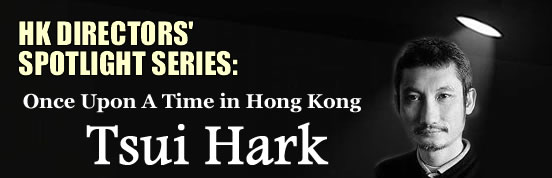
When film scholars look back at the Hong Kong film industry,
no director could have claimed to have left a more indelible
mark than Tsui Hark (pronounced ‘choy hark’).
The man once dubbed ‘the Spielberg of Asia’
has produced and/or directed some of the most iconic
films of Golden Age of Hong Kong cinema in the 80s and
90s and in doing so, created new genres like the fantasy
‘wuxia pian’ that have since won fans all
over the world.
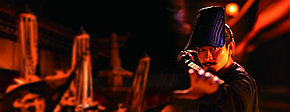 Besides
introducing new genres, Tsui Hark is also credited for
being the founding father of the special effects and
animation industries in Hong Kong- thanks to his films
“Zu: Warriors from the Magic Mountain” (1983)
and “A Chinese Ghost Story: The Animated Movie”
(1997) respectively. Yet the director regarded as the
best and brightest hope for Hong Kong cinema has of
late been a shadow of his former self. Besides
introducing new genres, Tsui Hark is also credited for
being the founding father of the special effects and
animation industries in Hong Kong- thanks to his films
“Zu: Warriors from the Magic Mountain” (1983)
and “A Chinese Ghost Story: The Animated Movie”
(1997) respectively. Yet the director regarded as the
best and brightest hope for Hong Kong cinema has of
late been a shadow of his former self.
In the past decade, the once-prolific Tsui Hark has
produced and directed more duds than hits- “The
Legend of Zu” (2001) and “Missing”
(2008) the notable misfires. Even his ‘wuxia’
opus “Seven Swords” (2005) failed to live
up to expectations, and any film bearing the title “a
Tsui Hark film” on the poster was greeted with
more apprehension than anticipation. It has been two
years since his last film- the inconsequential comedy
“All About Women” (2008)- and Tsui Hark
is back with a big-budget period action spectacle that
looks set to restore the lustre he has lost over the
years.
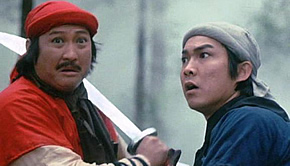 “Detective
Dee and the Mystery of the Phantom Flame” (2010)
debuted to positive reviews at the recently concluded
Venice Film Festival, where it was in competition for
the top prize of the Golden Lion. It didn’t win,
but it was enough to convince critics- us included-
that Tsui Hark may just have gotten his mojo back. Considering
how “Detective Dee” boasts the elements
of classic Tsui Hark films- wuxia, murder mystery, supernatural
fantasy- this homecoming is all the sweeter. “Detective
Dee and the Mystery of the Phantom Flame” (2010)
debuted to positive reviews at the recently concluded
Venice Film Festival, where it was in competition for
the top prize of the Golden Lion. It didn’t win,
but it was enough to convince critics- us included-
that Tsui Hark may just have gotten his mojo back. Considering
how “Detective Dee” boasts the elements
of classic Tsui Hark films- wuxia, murder mystery, supernatural
fantasy- this homecoming is all the sweeter.
As we await the arrival of “Detective Dee”
in cinemas this week, we look back at the long and illustrious
history of Tsui Hark, a trip down memory lane that anyone
who has ever been a fan of Hong Kong cinema will undoubtedly
find nostalgic.
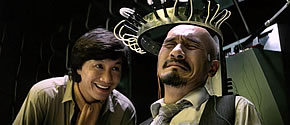
The Cinema City Days
Many of the biggest Hong Kong blockbusters in the 80s
came from a studio called Cinema City, founded by Raymond
Wong, Karl Maka and Dean Shek. Tsui Hark joined Cinema
City in 1981 and immediately struck box-office gold
with the comedy “All the Right Clues for the Wrong
Solution” (1981) as well as the third Aces Go
Places movie, “Our Man from Bond Street”
(1984).”
“By then, Tsui was already regarded as one of
the “New Wave” directors in Hong Kong cinema.
His feature film debut was The Butterfly Murders (1979),
a unique blend of the kind of elements in “Detective
Dee”. Just as distinctive were his follow-ups,
“We’re Going to Eat You” (1980) and
“Dangerous Encounter of the First Kind”
(1980) which made him the darling of film critics pushing
for change in the industry.
Some called him a sell-out when he joined Cinema City
and started making commercial films, but Tsui remained
an iconoclastic director. He imported Hollywood technicians
to help create the special effects in the 1983 wuxia
fantasy “Zu: Warriors from the Magic Mountain”
(1983) and by doing so led the charge of CGI into an
industry then way behind its Hollywood contemporaries.
Starting the Film Workshop
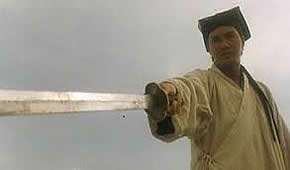 With his wife and long-time collaborator Nansun Shi,
Tsui Hark started his own production company Film Workshop
in 1984. Tsui’s first film under his own production
house was “Shanghai Blues” (1984), possibly
the first non-action comedy with an all-female cast.
The film was nominated for Best Film at the Hong Kong
Film Awards (HKFA) that year, and Tsui for Best Director
.
With his wife and long-time collaborator Nansun Shi,
Tsui Hark started his own production company Film Workshop
in 1984. Tsui’s first film under his own production
house was “Shanghai Blues” (1984), possibly
the first non-action comedy with an all-female cast.
The film was nominated for Best Film at the Hong Kong
Film Awards (HKFA) that year, and Tsui for Best Director
.
Tsui said of Film Workshop’s maiden venture: “My
thinking was that we should try something else, so we
did a non-action comedy with an all-female cast. Women
were rarely given significant roles before this movie.
But I said, "This is quite a boring thought, we
should try something away from the ideas that have been
established." The film was not greenlighted by
the company I was working for at that time (New Cinema
City), so that's why we formed Film Workshop.”
At Film Workshop, Tsui took charge of the creative and
production side of things while Nansun supervised 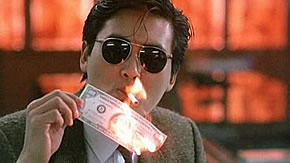 financials
and distribution. Film Workshop hit the ground running,
churning out hit after hit at a brisk pace. But Film
Workshop’s runaway success came with John Woo’s
A Better Tomorrow (1986), which they co-produced with
Cinema City. financials
and distribution. Film Workshop hit the ground running,
churning out hit after hit at a brisk pace. But Film
Workshop’s runaway success came with John Woo’s
A Better Tomorrow (1986), which they co-produced with
Cinema City.
Ranked #2 on the list of Best 100 Chinese motion pictures
by the HKFA, it broke box-office records in its time
and created easily the most iconic role in Chow Yun-Fat’s
career. Forever a watershed film for the hardboiled
triad film genre, it was followed by the troubled sequel
A Better Tomorrow 2 (1987). Not only did Cinema City
fall apart afterwards, it led to fallout between John
Woo and Tsui Hark- hence Tsui’s takeover of directorial
reins in the third instalment, A Better Tomorrow III:
Love and Death in Saigon (1989).
Breaking New Ground and Revisiting Old Ones
 With
his own production company, Tsui had the creative latitude
to make the films he wanted, especially when it came
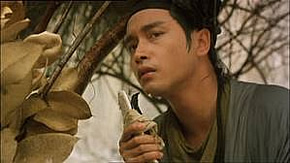
to experimenting with genres. He produced A Chinese
Ghost Story (1987)- directed by his long-time action
director/ collaborator Tony Ching Siu-tung- which introduced
the ‘ghost romance’ genre to Hong Kong audiences.
But even as he was breaking new ground for the industry,
he was also revisiting the classics to put his own stamp
on them. . With
his own production company, Tsui had the creative latitude
to make the films he wanted, especially when it came
to experimenting with genres. He produced A Chinese
Ghost Story (1987)- directed by his long-time action
director/ collaborator Tony Ching Siu-tung- which introduced
the ‘ghost romance’ genre to Hong Kong audiences.
But even as he was breaking new ground for the industry,
he was also revisiting the classics to put his own stamp
on them. .
Peking Opera Blues (1985) paid tribute to the tradition
of Peking Opera Tsui grew up with, The Swordsman (1990)
and its Jet Li-Brigitte Lin sequel Swordsman 2 (1992)
revived the classic wuxia genre, and Blade (1995) was
a bloody anti-heroic remake of the 1967 The One-Armed
Swordsman. Still, Tsui will probably best be remembered
for his take on the martial arts folk hero 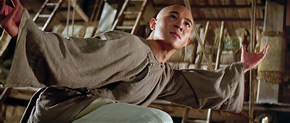 Wong
Fei-Hung in his career-defining masterpiece, Once Upon
a Time in China (1991). Credited for starting the martial
arts craze in the early 90s, the film ran for two months
in cinemas and won Tsui a Best Director award at the
HKFA. Wong
Fei-Hung in his career-defining masterpiece, Once Upon
a Time in China (1991). Credited for starting the martial
arts craze in the early 90s, the film ran for two months
in cinemas and won Tsui a Best Director award at the
HKFA.
The inevitable sequel followed, another equally successful
movie that was most notable for the climactic fight
scene between Jet Li’s Wong Fei-hung and Donnie
Yen’s corrupt Manchu official. Another sequel
with Jet Li followed, before Tsui would make yet another
two less successful movies with Chiu Mun-Cheok taking
over the lead role and retiring the series with Once
Upon A Time in China and America (1996) which he produced
and Sammo Hung directed. The franchise would probably
be forever remembered as the landmark of Tsui’s
career- as well as probably that of Jet Li’s .
TSUI
HARK Once Upon A Time In Hong Kong continues...
|
